










Every successful business needs to make the customers their top priority. Communication, relationship, and your dedication to customer satisfaction are some of the key elements that will help you gain their trust and loyalty. That's why you have to make sure all the communication channels are ready to provide customers with the information and feedback they're looking for. One of the most important channels is your cloud call center or customer support service.
In order to make your customer support service successful and keep the customers who are calling happy, you need to make sure your call agents know what they're doing. Training your call agents is a must, but they also need a call answering script to refer to. This will make all the calls equally successful.
Below, you'll find the guide on how to write the perfect call answering script and achieve maximum caller satisfaction. Let's take a closer look.
What is a call answering script?
Let’s start by defining and explaining the true meaning and importance of a call answering script. What is it?
A call answering script is a written manual that provides guidance to call representatives answering a call from potential or existing customers. But, a call answering script is not:
- Something you should learn by heart;
- Something you should read directly from during a call;
- Something you should never step away from.
It's important to understand that a call answering script is there to navigate the call in the right direction, but the call representative needs to be ready to improvise and consider each individual caller.
Why do you need a call answering script?
As you’re probably aware, everything you and your employees say, write, or publish online is a part of your brand. And, just like your social media posts help build your online presence, so do your customer support representatives who represent your brand over the phone.
A call answering script is necessary to:
- Provide a pleasant and helpful experience to all callers;
- Make all calls similar and equally successful;
- Reach the end goal of the call quickly; and
- Have more satisfied customers;
You can't allow your customers support representatives to speak to the customers as they please. A script will help them how to address the customers and behave during a call.
Writing the perfect call answering script
Now that you understand the importance of having a perfect call answering script, it’s time to think about the best practices for writing one. I’ve created a detailed guide that will help you write a winning call answering script for your business. For crafting a perfect call answering script, you can start on your own or take help from online content writing services available out there.
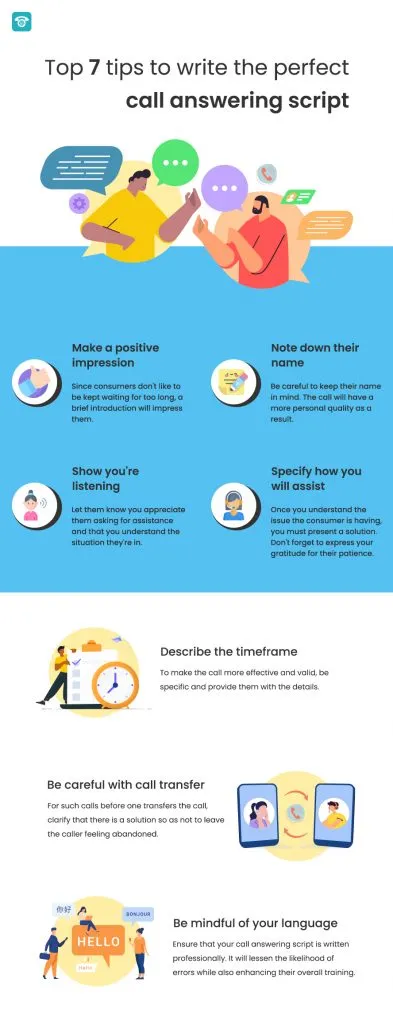
Here are my top 7 tips:
Nail the first impression
You only have one shot to make a great first impression when a customer calls. A great first impression means:
- The customers feel they can trust you;
- They sense you’re friendly; and
- They believe you want to help.
To make a great first impression, you and your agents have to:
- Use a friendly tone and voice;
- Greet the customers politely;
- Introduce yourself; and
- Allow the customers to speak.
In a nutshell, it should go something like this: “Good morning/good afternoon. This is [name of the representative] and thank you for calling [company name]. What can I help you with today?”
The introduction is brief, which will make the customers happy since they don't want to be kept waiting for too long. You go straight to the point, which is hearing out their problem. This type of introduction will help you make a great first impression.
Write their name down
Most customers who are calling will immediately tell you their name and start talking about the problem. Make sure you remember their name, so you can use it in the conversation later on. The best thing to do is to:
- Write their name or their company’s name down; and
- Write down the correct pronunciation.
If they didn't state their name, ask them early on in the call.
Using their name later on during the call will show them they're being heard and appreciated and you care for their needs. It will give the call a more personalized character.
Show you’re listening
Once the caller starts to explain the problem, they need to know that you’re listening closely. Firstly, let them know you understand the position they’re in and appreciate them calling for help. It would be best to say:
“[Customer name], I understand how frustrating this is for you, and I’m sorry for your inconvenience.”
It would be best for you to listen, take notes, and sum up the problem they’re facing or the information they need. This will make them feel like they’re closer to accomplishing the goal of their call. Here’s an example:
"I understand. Just to confirm, you’re calling to learn why your account still hasn’t shown your latest order. Is that correct?"
It's always a good idea to ask questions the callers will answer with a "yes." This will help you move the conversation forward using a friendly tone and mutual understanding.
Explain how you’ll help
Once you’ve made sure that you understand the problem the customer is facing, you need to offer a solution to their problem. That’s the reason they’re calling so make sure you tell them exactly how you plan on solving their issue.
Also, don't forget to thank them for their patience and say you're glad they called you. Make them feel encouraged and happy for they decided to call your customer support.
So, explain how you'll help them:
“Thank you for your patience [Customer name]. I’m happy you called us today. I’m immediately going to check your order status and…”
Briefly explain the steps you plan on taking and how those steps will solve the customer’s problem.
Address the time frame
The callers must understand exactly how much time you'll need to make this problem go away. Leaving out the exact time frame might make them more frustrated or feeling like they're back to square one.
So make sure you give a time reference to every caller. Here's a couple of examples:
- “I’m looking at your account right now, and I see what the problem is. I just changed your status and it should be visible on your account immediately.”
- “I might need a couple of minutes to sort this out. Do you mind staying on hold?”
- “Yes, I see what the problem is. I’ll send a request to my colleagues at the [another department]and you’ll be able to access your account tomorrow morning.”
With a precise deadline or timeframe for solving the problem, your customers will have something to hold on to while waiting for the solution. Be precise and give them this information to make the call more valid and productive.
Be careful with call transfer
From time to time, you’ll receive a call that is simply not your responsibility. After listening and understanding the problem, you’ll have to transfer the call to another colleague.
This is something you need to do carefully, and here's why:
- You don’t want the caller to feel abandoned;
- You don’t want them to think you don’t want to help them; and
- They might feel like the next person won’t be of any help either.
This is why you need to explain a couple of things before you transfer the call:
- Why you can’t help them:
“I understand your problem, but it is not in my power to deal with it.”
- Explain there’s still a solution:
“Luckily, my colleague from the [another department] will be happy to help you.”
- Introduce the new person:
“I will transfer the call to [name of the new representative]. She’s an expert and will solve your problem quickly.”
Once you put it this way, the caller will be happy to have their call transferred to the other person.
Watch your language
Finally, when you’re writing a call answering script, you have to make sure it’s professionally written. This will decrease the number of potential mistakes your call representatives might make and help them all sound professional and well-trained.
So, edit and proofread your script for:
- A consistent style of writing;
- Consistent vocabulary;
- Grammar and punctuation; and
- Tone.
You want your call representatives to take their responsibilities seriously, so the script needs to be flawless. In case you want a professional to check your script content, there are online writing services that provide academic writing assistance. They can edit and proofread your scripts.
Polish it to perfection before submitting it to your call representatives to read and start using.
Final thoughts on call answering script
Writing the perfect call answering script is a challenging task since there are so many turns a call could take. But, you must put the focus on one single goal: Helping callers solve their problem.
Use the tips I've shared above to write a call answering script that will help you and your call representatives communicate better and solve problems easier.
.avif)



.webp)


