








An AI Voice Agent is an AI-powered phone agent that answers inbound calls, places outbound calls, understands natural speech, qualifies leads, resolves routine queries, and hands off complex conversations to your team with full context.
Unlike traditional IVR systems that rely on keypad menus, an AI Voice Agent can hold natural conversations and handle higher call volumes without adding headcount.
Indian businesses now use AI Voice Agents for sales, support, appointment booking, lead qualification, and after-hours coverage. Choosing the right platform matters more than ever.
This guide covers what an AI Voice Agent is, how it works, what it costs, how it stacks up against traditional IVR, and what to evaluate before you deploy one in 2026.
Why Voice AI Adoption In India Reached A Tipping Point In 2026
The answer isn't AI hype. Five converging trends made 2026 the year of voice AI in India.
Call volumes are rising, and staffing hasn't kept pace.
Call centers lose agents at a rate of 30-45% annually, one of the highest attrition rates of any industry. Replacing them means recruiting, onboarding, and training, plus the lost productivity in between. For a 100-agent call center, that cycle alone can cost $2.25-4.6 million annually. Indian businesses aren’t choosing AI over people; they’re choosing it because hiring and retaining talent at scale has become unsustainable.
After-hours and overflow calls are revenue.
Small and mid-size service businesses miss 25-40% of inbound calls during business hours, and that climbs to ~60% after hours, when most Indian SMBs have no live coverage at all. The cost compounds fast: 85% of callers who hit voicemail never call back, and 78% of customers go with whichever business responds first, regardless of price or reputation. Speed, not persuasion, wins the lead: MIT Sloan's widely cited research shows that contacting a lead within 5 minutes instead of 30 improves qualification odds by 21x, a gap no human-only calling team can consistently close.
Multilingual expectations have shifted from nice-to-have to default.
88% of Indians say they trust content and communication in their native language more than English, and 68% actively prefer it, according to IAMAI & Nielsen, 2024. This isn't a metro-versus-rural story anymore. RBI has directed banks to build multilingual contact centers and grievance systems to meet this expectation, with vernacular voice interactions growing sharply across sectors. A business that only serves customers in English is, by definition, underserving a large share of its own market.
Voice AI technology has genuinely improved tenfold.
Two years ago, "multilingual voice AI" mostly meant awkward, robotic translations. That's no longer true. In 2026, AI speech models handle Hinglish, Hindi, Tamil, Telugu, and every major Indian language with strong recognition accuracy and natural-sounding synthesis. Modern conversational agents, including MyOperator’s AI Voice Agents, manage mid-sentence code-switching (a caller moving between languages in the same conversation). The technology has crossed a threshold of usefulness: deployment is now an accessible competitive advantage.
AI deployment economics now make sense at scale.
Gartner projects that conversational AI will cut global contact center labor costs by $80 billion in 2026. AI won’t fully replace traditional call centers yet, though it’s already automating a modest share of customer interactions. On a per-interaction basis, voice AI costs roughly 65-90% less than a human-handled call.
Put together: rising staffing costs, missed after-hours revenue, a multilingual customer base, smarter AI models, and improved unit economics make conversational AI voice agents viable even for small teams.
Voice AI adoption in India didn't happen gradually. It happened all at once.
The question now isn't whether to adopt AI agents for calls. It's which use case, language coverage, setup configuration, and deployment model actually fits your call volume.
Because your future-focused competitor is already evaluating these factors.
What Is An AI Voice Agent?
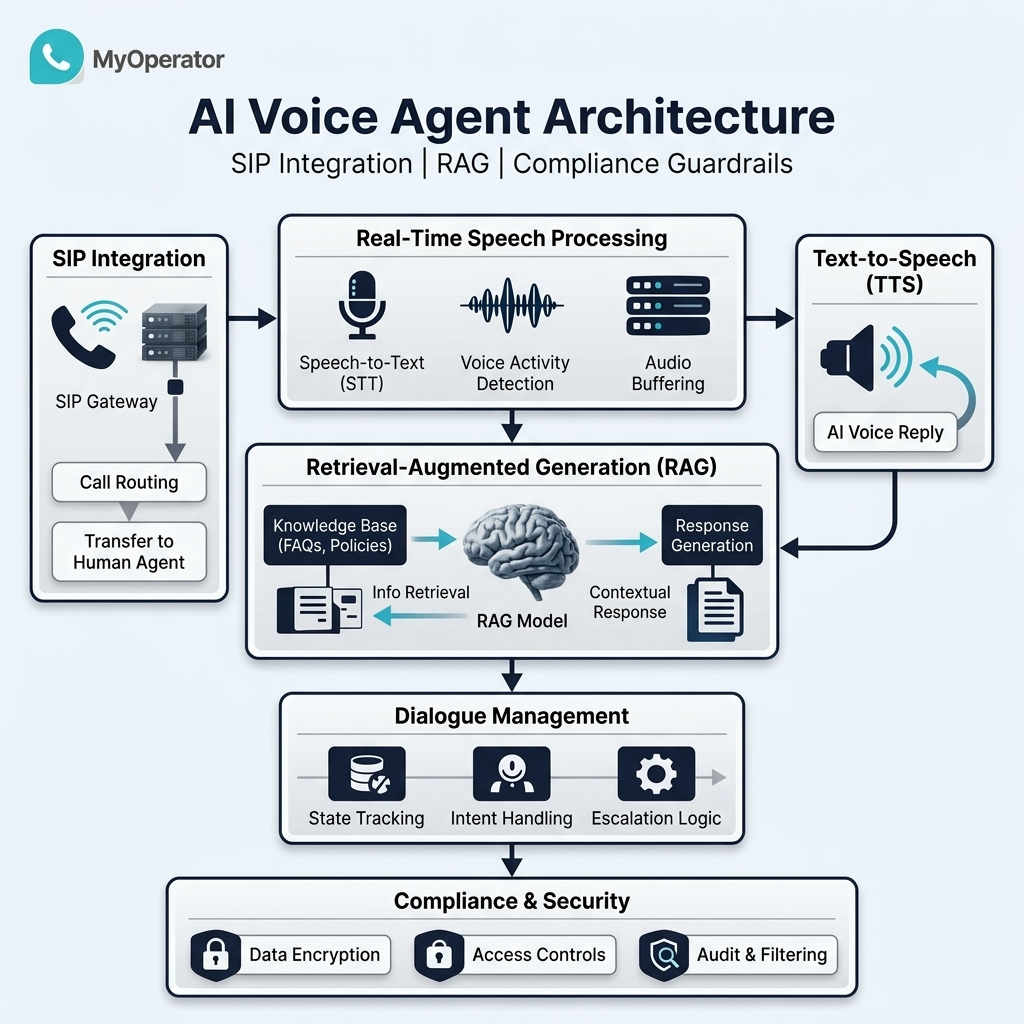
An AI voice agent is a system that answers inbound calls or places outbound calls, understands natural spoken language, and either resolves the call directly or routes it to the right person with full context already captured. It's not a keypress-driven IVR tree. It listens, understands intent, and responds conversationally in English, Hindi, or a mix of both.
For a deeper breakdown of how this differs from a traditional bot or IVR, see our explainer on what an AI voice agent actually is and how it differs from an AI bot.
Two distinct use cases fall under this umbrella: inbound voice agents that answer and triage calls, and outbound voice agents that place calls to qualify leads, confirm appointments, or follow up on inquiries.
Most businesses start with one and add the other once the first is working.
How AI Voice Agents Handle Calls: Inbound, Outbound, and Unified
The mechanics are straightforward: inbound agents answer, outbound agents dial, and unified agents do both on the same platform.
Inbound AI Voice Agents
A customer calls your business number.
The AI voice agent greets the caller and listens for intent: a booking inquiry, a support question, a request for a specific department.
Based on intent, it either resolves the query directly (pricing, availability, hours, etc.) or routes the call to the right team.
If the call needs a human, it hands off with full context captured, so the caller doesn't repeat themselves.
Outbound AI Voice Agents
The AI voice agent places an outbound call to a lead from a defined list.
It introduces the product, brand, or service in English, Hindi, Hinglish, or other languages for Indian audiences and asks qualifying questions.
Based on the response, it books a follow-up, escalates a warm lead to sales, or logs the outcome and moves to the next call.
For a detailed step-by-step breakdown of how an outbound AI voice agent runs a sales call: AI Calling Agent for Outbound Sales: How It Works.
Unified AI Voice Agents Inbound + Outbound
Most businesses start by solving whichever calling problem is more painful: missed inbound calls or scaling outbound calls. The real efficiency gain comes when both workflows run on the same platform, because the customer context stays unified.
A lead qualified via an outbound call who calls back with a question shouldn't be treated like a stranger. MyOperator's Business AI Operator is built around this reality: voice AI agents, WhatsApp chat, and calls share a single customer record.
Both flows remove the same bottleneck: a human team that can only be in one conversation at a time, while calls keep coming in or a lead list keeps waiting.
That bottleneck is what traditional IVR was supposed to solve. However, there’s a major difference between IVR systems and AI voice agents.
AI Voice Agent vs Traditional IVR: What Changes for Your Business
How Much Is Your Legacy IVR Costing You Every Year?
Now that you know how conversational AI improves on IVR, the next step is simple: estimate what your own IVR system is costing you in lost revenue.
It takes less than 30 seconds.
An IVR routes, but an AI voice agent understands and resolves issues. If you’re still asking callers to press a number and wait before talking to a human, you are silently losing revenue every day.
Read Now: IVR vs AI IVR: 3 Reasons Smart Businesses Are Switching
The next question is what successful Indian businesses are doing with voice AI Agents right now, and whether those use cases match yours.
How Indian Businesses Use AI Voice Agents: Use Cases, Examples, And Real Deployments
Inbound call handling and intelligent routing
Greeting callers, understanding intent through natural speech, and routing to the right team or location. This replaces the keypress menu with a conversation and eliminates the most common caller complaint: being sent to the wrong department.
Case in point: DavaIndia (Zota Healthcare), India's largest private generic pharmacy chain with 2,100+ outlets, deployed MyOperator's AI Receptionist to screen 80-120 daily calls for its Group CEO. The AI agent identifies caller intent, fast-tracks known contacts, and routes by priority. Result: the CEO reclaimed 2 hours of focus time daily, and the PA's manual screening workload dropped by 93%.
Appointment and booking confirmation
Automated calls confirm bookings, reservations, or appointments, with rescheduling handled conversationally rather than through a missed-call callback loop. For appointment-heavy businesses (clinics, salons, real estate), this is often the first deployment. See our guide on setting up an AI receptionist for the setup path.
Outbound lead qualification at scale
Calling prospects to introduce a product, answer initial pricing questions, qualify interest, and hand off warm leads to a human sales consultant. The volume advantage is the point: an AI voice agent makes 200 calls in the same time a human makes 20, with consistent script adherence and zero fatigue.
Case in point: Munshi Financials, a B2B outsourcing platform for CA firms and financial professionals, used MyOperator's AI Voice Agent to scale pan-India partner acquisition. The AI agent handles identity verification, consent, and intent qualification, and triggers WhatsApp rate cards for interested partners. Outbound capacity jumped from 250 to 1,000+ calls/day, and qualified lead escalations grew 5x, all without adding a single person to the calling team.
After-hours coverage
Answering calls outside business hours instead of sending every after-hours caller to voicemail. The AI agent captures the inquiry, qualifies urgency, and either resolves it or queues a callback for the morning, with context intact.
For the full picture of how Indian SMBs are deploying AI agents across voice and WhatsApp (including adoption rates by industry and the patterns that separate successful deployments from stalled ones), see How Indian SMBs Are Using AI Agents in 2026: Findings From 300+ Deployments
The next section covers what to verify before you buy one, because the vendor's pitch will always sound convincing.
What to Check Before You Deploy an AI Voice Agent in India
Most Indian SMBs and mid-market businesses are new to AI voice agents. Here’s what you should know before you deploy one for the first time.
- Natural language understanding that actually handles Hinglish. Not keyword matching on a scripted prompt, but a system that follows a caller who switches from English to Hindi mid-sentence without breaking.
- Both inbound and outbound capability, or a clear path to add the second. Most businesses start with one. The ones that get the most value combine both on a unified platform, even if you don’t need both at the outset.
- Clean human handoff with complete caller context. An escalated call where the customer has to repeat everything they told the AI agent is worse than no automation.
- Integration with your existing business tools. AI Voice Agent should automatically update your CRM, helpdesk, or business systems after every call, eliminating manual data entry.
- Reporting resolution rate and average handle time (AHT). Because what matters is not the number of calls handled, but how many queries were resolved and how fast.
- Realistic setup timelines. Standard configurations should take days, not months. If a vendor quotes you a 12-week implementation, you're buying enterprise infrastructure you may not need.
Check these boxes before you deploy. Here’s a structured comparison of the 10 best voice AI platforms in India.
The harder question comes after deployment: how do you know if your Voice AI Agent is actually working?
How to Measure Whether Your AI Voice Agent Is Working? AI Agent Metrics To Know
Calls answered is a vanity metric. An AI voice agent that answers every call but resolves only a few is a poor investment.
That is the exact problem with 24/7 AI Agents, especially calling AI agents, because callers are stuck in a loop without any escalation or resolution.
A well-configured AI voice agent can reduce average handle time (AHT) for calls by up to 40% with instant resolutions, instead of making callers wait in a live queue.
Track these AI voice agent metrics, in this order of priority, to evaluate its performance:
- Containment rate: percentage of calls resolved without human handoff. This is the number that tells you whether the AI is actually doing work or just answering the phone.
- Average handle time (AHT): measure before and after deployment. If AHT doesn't drop, the agent is adding a layer, not removing one.
- Escalation quality: when the AI does a handoff, does the human agent have enough context to pick up without asking the caller to start over?
- CSAT on resolved calls: Measuring customer satisfaction on calls the AI handles tells you about your AI agent’s effectiveness.
These metrics will surface problems fast.
But some mistakes happen upstream, even before the AI voice agent goes live. Here are the configuration and strategy errors we see most often across deployments.
7 Mistakes Indian Businesses Make With AI Voice Agents
1. Deploying inbound-only when outbound qualification would solve a bigger problem. If your team spends more time dialling cold leads than answering calls, start with outbound.
2. Using generic scripts instead of training on real call logs. A voice agent trained on your actual FAQs and call patterns performs differently from one running a vendor's default template.
3. No escalation path for edge cases. A caller stuck with a conversational AI agent who can't help and won't hand off is even worse than a missed call. They're frustrated and still unresolved.
4. Measuring calls answered instead of calls resolved. Volume answered is a vanity metric. Resolution rate and AHT reduction are the numbers that matter.
5. Same configuration for peak hours and off-peak. Peak-hour call patterns are different: shorter patience, higher intent, more code-switching. Configure accordingly.
6. No review cycle after launch. A voice agent trained once and never updated drifts out of date as your products, pricing, and policies change.
7. Treating the voice agent as a standalone tool instead of part of a communication stack. A customer who calls in the morning and messages on WhatsApp in the afternoon should be one conversation, not two.
None of these seven mistakes are about the AI being immature. They're deployment decisions that separate an optimized AI voice setup from a chaotic one.
That last mistake, treating voice as its own silo, is usually the biggest blind spot.
Here's what an AI voice agent looks like when it's part of a unified customer communication ecosystem, instead of a bolt-on to your existing stack.
MyOperator's AI Voice Agents: Why Choose Business AI Operator
This section is the starting point for every Indian business exploring AI voice agents. Each MyOperator AI agent is purpose-built for a specific use case, designed for the needs of Indian SMBs, and built to avoid the seven setup mistakes above.
Explore the one that matches your business needs.
All AI agents mentioned above run on the Business AI Operator platform, unifying voice AI agents, WhatsApp AI agents, call management, and workflow automation under one system.
See how the Business AI Operator helps your business respond instantly to every call and chat, deliver 24/7 customer communication without round-the-clock staff, and scale without adding headcount.
Explore Business AI Operator →
Where Indian Businesses Should Start With AI Voice Agents
If you're reading this guide, you've probably already decided that your current call setup isn't working well enough. The front desk is overwhelmed, outbound is slow, or you're losing after-hours leads to voicemail.
An AI voice agent fixes those problems, and the technology is past the proof-of-concept stage for Indian businesses.
The practical question isn't "should we use AI for voice?"
The question you need to ask is: “what use case do I start with?”
Whether it’s missed calls, outbound qualification, or a unified calling platform that handles both calls and chat, start with the workflow that is the weakest link right now.
An AI Voice Agent is only one part of modern customer communication.
MyOperator brings AI Voice Agents, Chat AI Agents, Calls, WhatsApp, and human teams together with the Business AI Operator platform.
If you use WhatsApp for customer interactions, the Complete Business Guide On AI Chat Agents In India covers the same decision framework for chat-based AI agents.
.avif)



.webp)


