








Most businesses do not lose customers because nobody answers the phone. They lose customers because nobody takes ownership of the missed conversation.
A missed call can be recovered. A delayed response can be explained. What businesses struggle to recover from are long wait times, repeated transfers, and customers feeling that nobody is helping them move forward.
As inquiries grow, customer expectations rise just as quickly. High-intent queries arrive via calls, WhatsApp messages, and website chat simultaneously, while teams spend valuable time answering repetitive questions. Without an AI receptionist, businesses struggle to provide the instant, consistent experience modern customers expect.
This is where AI-powered receptionists are changing how businesses manage customer communication. Unlike a traditional virtual receptionist or virtual answering service, it doesn't just answer calls. It acts as the first layer of customer communication, ensuring every inquiry is acknowledged, qualified, routed, and tracked from the moment it arrives.
Whether deployed as an AI front desk for enterprises or an AI phone receptionist for a small business, it ensures no opportunity is lost due to staff unavailability, delayed responses, or manual handoffs.
What Is An AI Receptionist And Why Do Businesses Need One?
An AI receptionist is an AI-powered virtual front desk that answers incoming calls, understands customer intent, qualifies enquiries, routes conversations, books appointments, captures lead information, and escalates customers to human teams when required.
Unlike traditional IVR systems that rely on button presses and predefined menus, an AI-powered receptionist can engage in natural conversations, ask follow-up questions, understand context, and take action based on customer responses.
For businesses, this means every incoming call receives a structured response, even when the front desk staff is unavailable.
An AI voice agent as a virtual front desk receptionist can:
- Answer incoming calls instantly
- Capture caller information
- Understand why a customer is calling
- Route conversations to the right department
- Schedule appointments and callbacks
- Answer common questions
- Escalate conversations to human teams when needed
For most businesses, the challenge is rarely a lack of people. The bigger constraint is how much time skilled employees spend on repetitive conversations that could be handled more efficiently by AI Agents.
An AI receptionist helps businesses reclaim that time while ensuring customers still receive immediate attention.
AI Receptionist vs Traditional Phone Answering: What's the Difference?
Traditional phone answering services focus on ensuring calls are answered. An AI receptionist extends that role by understanding why customers are calling, collecting relevant information, and helping conversations move toward a clear outcome.
How To Set Up An AI Receptionist: A Step-by-Step Guide For Indian Businesses
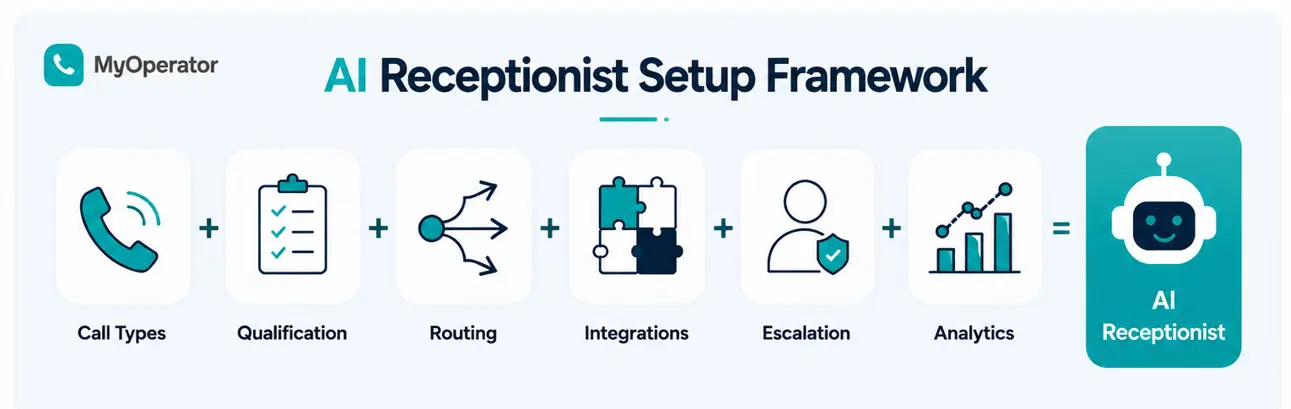
Many businesses assume that deploying an AI receptionist starts with selecting the right software. In reality, successful deployments begin with workflow design.
Most virtual AI receptionists don’t fail because of technology. They fail because nobody agreed on what should happen when a customer calls.
Step 1: Identify Your Most Common Caller Intents
Start by understanding why customers contact your business. For most SMBs, calls usually fall into a few predictable categories:
- New sales enquiries
- Customer support requests
- Appointment bookings
- Billing questions
- Existing customer follow-ups
For example, a dental clinic may receive calls related to:
- New appointments
- Appointment rescheduling
- Treatment enquiries
- Emergency consultations
A real estate business may receive calls related to:
- Project enquiries
- Site visit requests
- Pricing questions
- Existing customer support
The goal is to build your AI receptionist around real customer conversations rather than generic call-handling workflows.
Step 2: Create Your Receptionist Greeting
The first interaction shapes the entire customer experience.
A good greeting should introduce the business, explain how the AI receptionist can help, and encourage the caller to explain their requirement.
Example:
"Hello, thank you for calling ABC Dental Clinic. I can help you book appointments, answer common questions, or connect you with our team. How may I help you today?"
The greeting should feel natural, professional, and aligned with your brand. Avoid overly scripted introductions that force customers through unnecessary steps.
Step 3: Build Qualification Questions
The purpose of qualification is not to ask as many questions as possible, but to gather enough information to route the conversation correctly.
For example, a dental clinic may use:
- Are you a new or existing patient?
- What treatment are you looking for?
- Which day would you prefer to visit?
A real estate company may ask:
- Which location are you interested in?
- What is your estimated budget?
- Are you planning to buy immediately?
Shorter qualification flows generally perform better because customers receive assistance faster.
Step 4: Define Routing Rules
Not every caller should follow the same path. This is where routing rules are important to determine where a caller is redirected after qualification.
Here’s a simple example:
Well-designed routing reduces response times and ensures customers reach the right person without being transferred repeatedly.
Step 5: Configure After-Hours Call Handling
Customer inquiries don’t stop when your office closes. One of the biggest advantages of an AI receptionist is its ability to handle conversations and qualify leads outside business hours.
For example:
Your goal is to ensure customers always receive a timely response, even when your team is unavailable.
Step 6: Connect Your Business Systems
An AI receptionist is significantly more valuable when it can access the same information your team has.
Common integrations include:
- CRM platforms
- Calendars
- Lead forms
- Helpdesk systems
- Email workflows
- WhatsApp workflows
For example, if a customer books a consultation on call, the AI receptionist can automatically:
- Check the shared calendar for slots
- Schedule an appointment
- Create a CRM record
- Notify the assigned team member via email
- Send a confirmation message to the lead
This eliminates manual follow-up work, reduces operational delays, and automates conversations end-to-end.
View all integrations for MyOperator AI Receptionist here
Step 7: Configure Human Escalation Rules
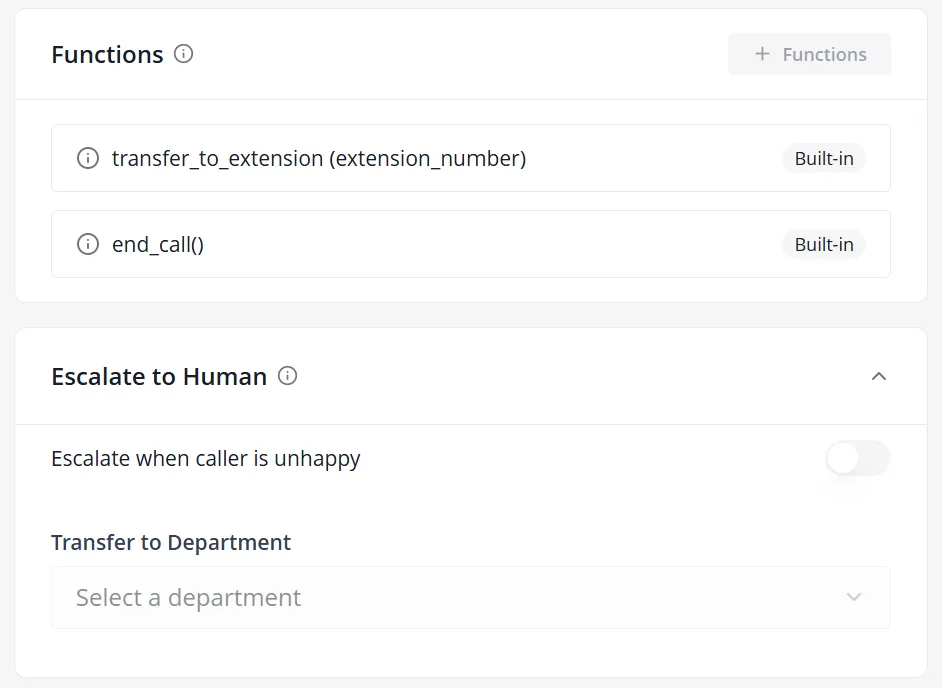
AI automation should never trap customers. The most effective AI receptionist workflows recognize situations where human intervention is necessary and transfer the conversation immediately.
Examples include:
- The caller asks to speak to a person
- A high-value lead is identified
- Negative sentiment is detected
- The same question is repeated multiple times
- An urgent request that requires immediate attention
The quality of the human handoff is often more important than the automation itself. Customers rarely judge a business based on whether AI was involved in the interaction. They judge it based on whether they reached the right person when the situation required human assistance.
Common AI Receptionist Setup Mistakes And How To Fix Them
MyOperator has 15+ years of experience in IVR and cloud telephony. In our experience, when a deployment like an AI receptionist underperforms, businesses often blame the technology.
However, more often than not, the problem is the actual workflow design. Here are common mistakes to avoid and how to fix them.
Treating The Receptionist As A Call-Answering Tool
An AI receptionist should not simply answer calls. Its role is to qualify intent, collect information, route conversations, and help customers reach the right destination. Businesses that use voice AI agents for answering calls often leave significant value untapped.
Asking Too Many Questions
Customers call because they want help. Long qualification flows with several questions create unnecessary friction. Collect only the information needed to move the conversation forward.
Weak Escalation Rules
Customers should never struggle to reach a human when the situation requires it. Clearly define escalation paths and triggers for your AI receptionist to allow immediate human handoff.
Ignoring Caller Frustration
Forcing customers to interact with AI when they need human assistance quickly erodes user trust. Your AI receptionist should detect frustration, repeated questions, or unresolved issues and escalate the conversation immediately to a human agent.
MyOperator's AI Receptionist includes frustration-detection capabilities that can trigger an immediate handoff to a human team member when the conversation requires intervention.
Never Reviewing Performance
Customer communication changes constantly. Businesses should regularly review common caller intents, routing effectiveness, escalation patterns, lead quality, and missed calls to improve continuously over time.
While these principles hold for all AI receptionists, the Indian context needs some additional considerations.
What Makes AI Receptionist Workflows Different In India?
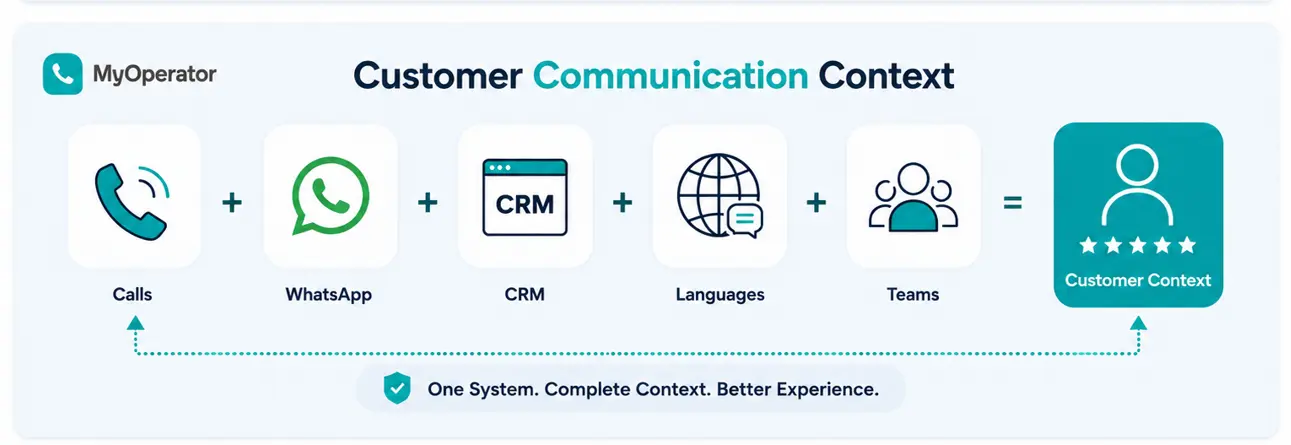
A customer might discover your business on Google, ask a question on WhatsApp, call for more details, and expect every interaction to carry context. An AI receptionist in India needs to do more than answer calls; it must connect communication channels, business systems, and teams into a single workflow.
Language adds another layer of complexity.
Customers frequently switch between English and regional languages while discussing pricing, support, or purchase decisions, making multilingual conversations essential rather than optional.
An effective AI receptionist for Indian businesses should support:
- Voice-first communication
- Multilingual conversations
- CRM and business system integrations
- WhatsApp workflows
- Intelligent call routing
- Seamless human escalation
Businesses that unify these capabilities create faster, more consistent customer experiences while ensuring no inquiry is lost, even when conversations move across channels.
Why Businesses Choose MyOperator's AI Receptionist
Most businesses don't struggle with answering calls or even call automation. They struggle to meet the customers' expectation of instant responses. When customer context exists across calls, WhatsApp, and CRM systems, the result is often a fragmented customer experience.
Built on 15+ years of cloud telephony expertise, MyOperator's AI Receptionist unifies AI-powered conversations, intelligent call routing, multilingual support, lead capture, WhatsApp workflows, and CRM integrations into a single communication platform.
Instead of stitching together separate tools for telephony, automation, analytics, and customer management, businesses can automate first-level interactions while maintaining complete visibility and context throughout the customer journey.
The goal isn't to replace human-to-human conversations. It's to ensure every inquiry is acknowledged instantly, qualified accurately, routed to the right team, and followed through, regardless of when or how the customer reaches out.
For growing businesses, an AI receptionist is more than a call answering solution. It becomes the front door to every customer conversation.
.avif)



.webp)


