








AI vendors in 2026 are leading with a bold promise: "Deploy our AI agent and your team never has to touch a customer conversation again.”
Zero-touch AI is an emerging concept where fully automated, always-on AI agents run business workflows autonomously without human help. This has made “zero human involvement” the default pitch of AI vendors in 2026. It sounds like efficiency, but it's just deflection.
Before you buy into this, ask one question: who does zero human involvement actually serve?
It's a legitimate selling point for a narrow category of use cases with high volume, low stakes, and predictable queries. In those contexts, paying for a human-in-the-loop (HITL) is a waste of money. But for most Indian businesses, deploying AI agents for sales qualification, customer support, bookings, and lead capture, the zero-touch promise is how vendors avoid hard conversations.
This piece outlines zero-touch AI agents, what happens to a query that’s outside the AI’s scope, and four questions to evaluate whether your zero-touch AI deployment is set up for failure.
Why Most AI Vendors Lead With "Zero Human Involvement"
The zero-touch pitch comes from the enterprise automation playbook: identify a manual process, remove the human from the loop, and measure the cost savings. Applied to call centre operations at scale, this produced enormous productivity gains in the 2010s. Applied to narrow, well-defined workflows, it still does.
The problem is AI vendors often frame this in contexts where it doesn't belong. The Gartner prediction that 80% of customer service interactions will be handled without a human by 2029 is cited by most AI vendors as the goal every business should be working towards. It has become the benchmark for what a "good" AI deployment looks like.
That benchmark assumes the customer interactions that are being automated are the same kind of interactions. For most Indian SMBs in 2026, AI-powered customer interactions span lead qualification, booking confirmations, complaint resolution, and follow-ups. They are not low-stakes, predictable queries. They're the ones where getting one response wrong can lose a customer.
Zero-Touch AI Agents in 2026: Which Businesses Benefit From Full Automation
Zero human involvement as a genuine AI automation goal is appropriate only for a specific set of conditions:
- Very high volume, very low stakes: Consider a D2C e-commerce brand sending 50,000 COD order confirmation calls per day, a bank sending OTP authentication to 2 million customers daily, or a telecom company sending plan renewal reminders to an entire subscriber base. These are predictable, low-stakes, high-volume interactions where zero human involvement is genuinely possible.
- Single-intent, no-judgment required: Interactions such as "Confirm this is your delivery address" or "Your bill is ₹1,249. Press the link to pay" are interactions with one path and no branching logic. Zero-touch AI chat agents or voice AI agents work here because there's nothing to judge.
- Where the cost of failure is low: If the AI gets it wrong, the customer simply hangs up and the transaction retries without damaging the customer relationship. Nobody is offended and the customer relationship isn’t damaged. A customer who doesn’t receive an OTP and simply requests another one without losing trust in their brand.
For every use case outside these parameters, and most Indian SMB use cases genuinely lie outside them, the zero-touch AI pitch is a failure mode dressed up as a feature.
Where Zero-Touch AI Breaks Down for Indian Businesses
Three scenarios where zero human involvement produces worse outcomes than a well-designed human-in-the-loop system. If your AI agent doesn’t have a human fallback design, read the 7 triggers that should always escalate a conversation.
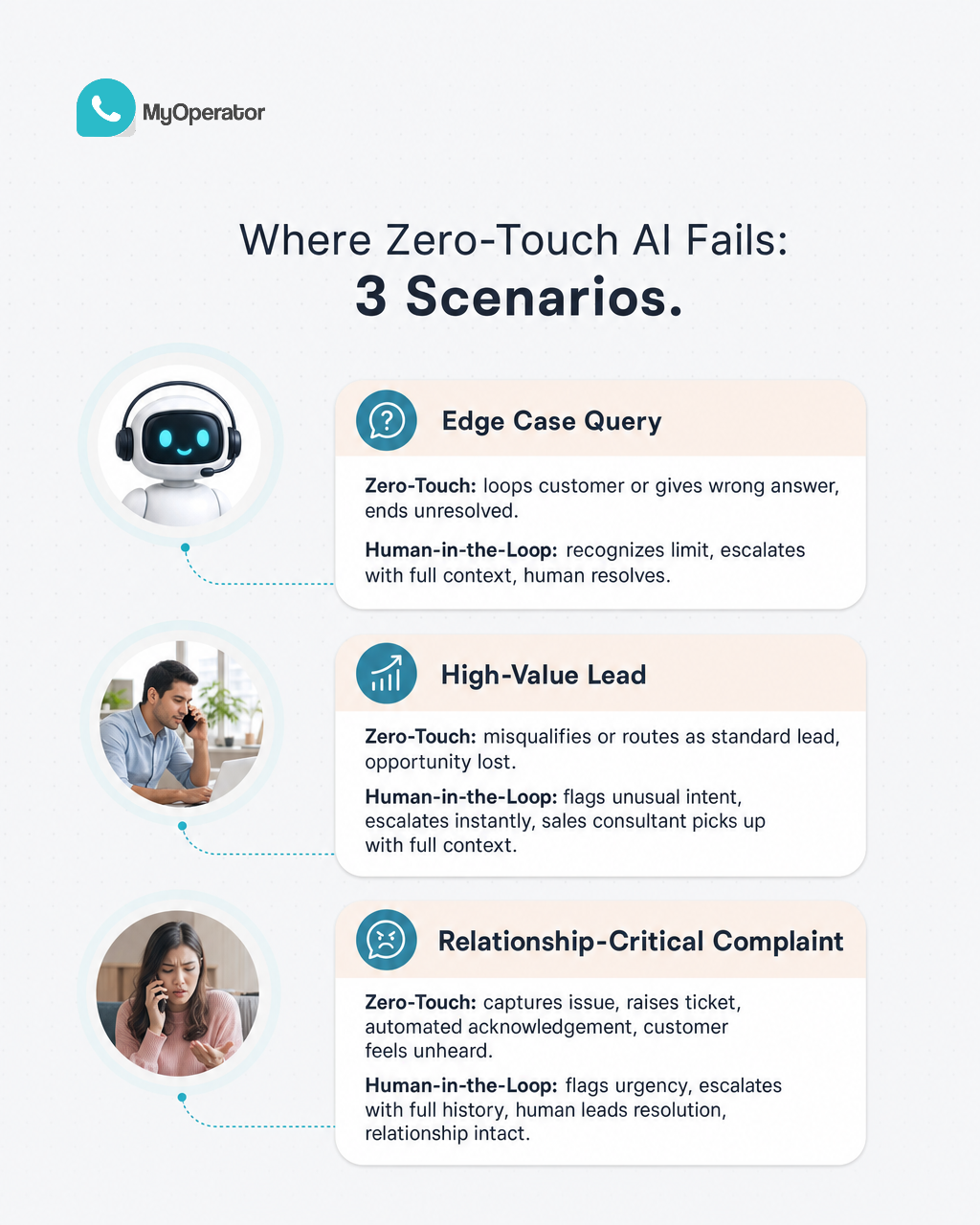
1. The AI Hits an Edge Case and Loops
A customer asks a question the AI wasn't configured for. In a zero-touch system, the agent has no escalation path. It either attempts an answer (producing the wrong information again), loops the customer through the same responses, or ends the conversation without resolving the query.
In a system with a human handoff, the agent recognizes the edge of its competence, and says "let me connect you with a human agent to help with that," and transfers with full conversation context. The customer might get annoyed for 10 seconds, but is ultimately satisfied with the handover. In the zero-touch AI system, they're annoyed and may never come back.
MyOperator CEO Ankit Jain’s session at Bharatpreneurs 2026 about why 95% AI deployments fail touched on this point. He said, "Let AI handle repetition. Keep humans responsible for judgment." The AI deployment that fails isn't one that escalates too often. It's the AI agent that doesn't know how to escalate at all.
2. The High-Value Conversation Gets Misqualified
A prospect with ₹20,00,000 worth of potential business sends a WhatsApp message at an unusual hour with an unusual request. A zero-touch AI qualification agent, configured for standard query patterns, either routes them to the team as just another lead or attempts to resolve the conversation that requires a sales consultant.
Human escalation for high-value, unusual, or time-sensitive conversations isn't a failure of the AI’s automation capabilities. It’s a feature that allows human agents to offload routine work to AI agents, so that they can handle the high-value cases. Businesses that deploy AI successfully recognize that the goal isn't to automate every interaction but to route conversations to the most effective responder: either AI agents or human agents.
3. The Relationship-Critical Conversation Gets Automated
A long-standing customer calls with a complaint. Zero-touch approach handles it as a routine support query by capturing the issue, raising a support ticket, and sending an automated acknowledgement. The customer expects to be heard, but all they get is a reference ticket number. Two days later, your human support team resolves the issue, but the relationship has already taken a hit.
Here, the AI didn't make a poor decision. It made the decision correctly for the category of interaction it is built for. The failure was deploying zero-touch AI automation to a category that sometimes requires human interaction.
Ankit Jain described a conversation with a client who expected their voice AI agent to handle all inbound calls. In production, it managed roughly 80%. The remaining 20% needed a human because those interactions carried stakes that no AI automation is built to handle.
4 Questions That Expose a Weak Zero-Touch AI Deployment
If you’re considering deploying a zero-touch AI agent, and your use case genuinely doesn’t overlap with the above scenarios, it’s still worth considering this checklist before signing a contract. Instead of "how much can your AI do without a human?", ask AI vendors these four questions:
- "What triggers an escalation to a human, and how is that configured?"
If the answer is "it doesn't escalate" or "escalation is optional," that's a red flag for any use case involving human judgment. If the answer is a specific set of configurable triggers, such as sentiment detection, repeat query flag, high-value lead flag, or unknown intent, that's the right architecture for an Indian business.
- "What does the human receive when a conversation is escalated?"
Full conversation history, caller intent, qualification responses, and the specific trigger that caused the escalation should be delivered instantly to a human agent. Anything less than this is a cold transfer that will break your AI-to-human handoff.
- "Who is managing this agent after deployment?"
Zero-touch automation requires a human monitoring it, updating its knowledge base, and catching performance drift.. The "zero human involvement" claim is specifically about customer-facing interactions, not the management, monitoring, and configuration. If it’s not a managed AI deployment, the zero-touch AI agent will drift as your business evolves.
- "Can you show me what happens when the agent doesn't understand a query?"
This is the key test on any demo. Every AI agent, however well configured, will encounter queries it wasn't trained on. The quality of the edge-case handling tells you more about the deployment than the spec sheet ever will. The ideal situation is a clean escalation with context.
What Successful Human-AI Handoff Looks Like in Practice
The reframe we’re suggesting is not "more humans" versus "fewer humans." It's placing a human-in-the-loop where it’s actually needed to influence the outcome.
The businesses getting the most out of AI deployments in 2026, based on an analysis of 260+ chat AI agents, are not the ones who automated everything. They're the ones who were precise about what they automated.
Volume without judgment frustrates customers. Judgment without scale breaks teams. The goal is to deploy a “AI + human” system where neither has to compensate for the other. That’s precisely the architecture MyOperator's Business AI Operator is built around.
The Business AI Operator Model: How It Decides Where A Human Should Step In
MyOperator doesn't build zero-touch AI agents. We build AI agents designed to know what they can handle and what they can't, and to route them to the right human agent immediately, with the full conversation context.
The Business AI Operator model, combining AI Agents, Human to Monitor, and Human to Handover, serves as the antidote to the zero-touch pitch. The AI agent handles volume. The AI Manager handles the agent. The human specialist handles what genuinely needs a person.
For the deployment evidence that this model works, the DavaIndia, Munshi Financials, and Aditya Hospitality case studies each show the same pattern: AI handles the volume reliably, humans handle edge cases and judgment, and the outcomes improved because both knew which customer interactions to handle.
"AI replaces the boring parts. And that's the best thing about AI," Ankit Jain said at Bharatpreneurs 2026. It does not replace relationship-building, emotional judgment, empathy, and objection-handling. It replaces the parts that were consuming time nobody wanted to spend.
That's the right scope for AI automation. Not zero human through zero-touch AI, but the right human involvement.
Related reads:
- Why 95% of AI Pilots Fail: MyOperator CEO Ankit Jain at Bharatpreneurs 2026
- AI Agent Human Handover: When to Escalate and How to Do It Right
- One AI Agent or a Full AI Team? How Indian Businesses Should Build Their AI Stack
- AI Agent Depth: What It Means, How to Measure It, and Why It Predicts Performance
.avif)



.webp)


