








The conversation about AI agents in India in 2026 is dominated by “what AI can do.” In 2026, AI-powered agents can answer calls, respond on WhatsApp, qualify leads, automate follow-ups, and handle customer communications in ways that were previously impossible for Indian SMBs.
But the question is: how are Indian businesses actually using AI agents right now?
This article analyzes 200+ live AI agents deployed on the MyOperator platform across industries like hospitality, healthcare, real estate, manufacturing, financial services, education, and D2C commerce.
These are not enterprise-size businesses with dedicated AI teams or monthly AI budgets. They are small and medium-sized businesses deploying chat AI agents and AI voice agents on the Business AI Operator platform to solve real business problems.
Learn what Indian SMBs are solving, why their AI agent deployments work, and what they reveal about the future of AI agents in India.
How Indian SMBs Are Using AI Agents Differently In 2026
In the context of an Indian SMB, an AI agent is not a scripted bot or a basic IVR system. It is an AI-powered system that understands user intent, known business-specific knowledge, and either resolves queries autonomously or routes them to the right person with full context.
On MyOperator's Business AI Operator platform, this takes two forms:
AI Voice Agents operate on calls, either answering inbound calls and routing them by intent, or making outbound calls to introduce services and qualify leads based on responses. In either scenario, it can hand off warm prospects to the sales team with a complete conversational summary.
AI Chat Agents operate on WhatsApp or web chat, handling inbound customer messages 24/7. They qualify intent, answer from the knowledge base, collect customer details, guide booking or purchase flows, and escalate complex conversations to a human agent.
While MyOperator AI Agents power customer communication for organizations ranging from growing SMBs to large enterprises, this analysis focuses on Indian SMBs with teams of 5 to 50 people who recognized that their biggest constraint was the ability to respond, qualify, and follow up consistently at scale.
Six AI Agent Use Cases Driving Real Business Results: Examples From 200+ Indian SMB Deployments
Across 200+ MyOperator AI deployments, six use cases show the strongest results across verticals. Businesses adopting AI Agents are not replacing employees but removing repetitive communication tasks that prevent small teams from scaling.
.webp)
Voice AI Agents for Call Handling and Lead Qualification
Businesses are using Voice AI Agents to answer inbound calls with up to 40% lower average handling time (AHT), qualify leads, route callers to the right team, and automate first-touch sales conversations. Common deployments include inquiry routing, lead generation, lead qualification, appointment scheduling, and outbound lead qualification campaigns that automate WhatsApp conversations end-to-end.
AI Chat Agents for Sales and Product Discovery
Manufacturers, distributors, and B2B businesses are deploying AI Chat Agents to answer product questions, share catalogs, explain pricing, and qualify buying intent on WhatsApp. Instead of sales teams spending hours on repetitive pre-sales conversations, qualified prospects reach human teams with context already captured.
AI Agents for Customer Support and Order Management
Customer support AI Agents are handling order status requests, return inquiries, delivery updates, and post-purchase support at scale. SMBs use them to reduce repetitive support workloads while ensuring unresolved issues are automatically escalated to the right team.
AI Agents for Bookings, Reservations, and Service Requests
Travel companies, cab operators, hospitality brands, and service businesses are using AI Agents to capture booking requirements, collect customer information, recommend suitable options, and guide customers through the reservation process across WhatsApp and calls.
AI Agents for Information Sharing and Operational Queries
Organizations with high volumes of repetitive inquiries use both voice and chat AI Agents as a first layer of customer communication. Instead of staff repeatedly answering the same questions about schedules, services, locations, pricing, or processes, customers receive instant responses while human teams focus on higher-value interactions.
.webp)
How Indian SMBs Deploy AI Agents Without An AI Team
If you think AI Agents are only useful for technology companies, consider this example.
One of the highest-performing AI Agent deployments in our dataset comes from a spiritual organization: Swami Rupeshwaranand Ashram. The organization wasn't trying to modernize its technology stack. It was simply looking to solve a capacity problem.
We saw similar successes for Value One, a digital marketing agency, and Hotel Maharaja Inn, a part of Aditya Hospitality's hotel chains.
The challenge wasn't a lack of talented people for either of these names. It was that the skilled staff were spending their time on work that didn't require human expertise. Instead of hiring more staff, they adopted an AI Chat Agent or a WhatsApp AI Chat Agent as the first layer of interaction.
None of these businesses had a dedicated AI team. None ran a pilot program.
Each identified a specific operational bottleneck and deployed an AI agent to handle that layer autonomously. We saw this pattern across successful AI deployment in our analysis.
The outcome in every case was the same: the humans got their time back, and the business captured more of the demand it was already generating.
MyOperator AI Agent is not about replacing humans. It is taking ownership of the repetitive tasks so humans can focus on the conversations, decisions, and relationships that actually require human judgment.
This is why most Indian SMBs don’t need an AI team to deploy AI Agents. They already know where the bottlenecks are. The Indian SMBs that see the strongest results from AI simply identified repetitive workflows limiting their growth and automated them with an AI Agent.
The question remains: why do some AI deployments compound into business advantages while others never move beyond a demo?

What Separates Successful AI Agents From Failed Deployments? 3 Traits Of Highest-Performing AI Agents In India
Across all 200+ AI agents, three characteristics separated the top-performing accounts.
Specialist AI Agents Outperform General-Purpose AI Agents
Every high-performing account runs specialist agents, each trained on a defined use case. An AI agent for bookings does not answer product pricing questions. An AI agent for customer support or lead generation do not handle FAQ-handling. Narrowly scoped agents improve accuracy, reduce escalation rates, and create more predictable outcomes.
Knowledge Base Quality Predicts Your AI Agent’s Performance
The strongest AI Agents rely on deeper, more informed knowledge bases. AI agents configured with more than 10,000 characters of instructions generated 12 times more engagement per user than agents using fewer than 2,000 characters (source: MyOperator platform data, June 2026). The businesses achieving the highest performance are not using a different technology. They are training their AI agents more thoroughly.
This is also why MyOperator's AI Agent plans include managed onboarding, workflow configuration, performance reviews, and ongoing optimization.
Successful AI Agents Know Exactly When To Escalate To Humans
The best AI Agents do not attempt to answer everything. Every deployment with a high containment rate has a clear escalation logic: the moment a query requires judgment, exception approval, or emotional handling, the AI agent routes to a human with complete context. Customers do not have to repeat themselves, and your human agents don’t have to guess.
What Most Indian SMBs Get Wrong About AI Agents
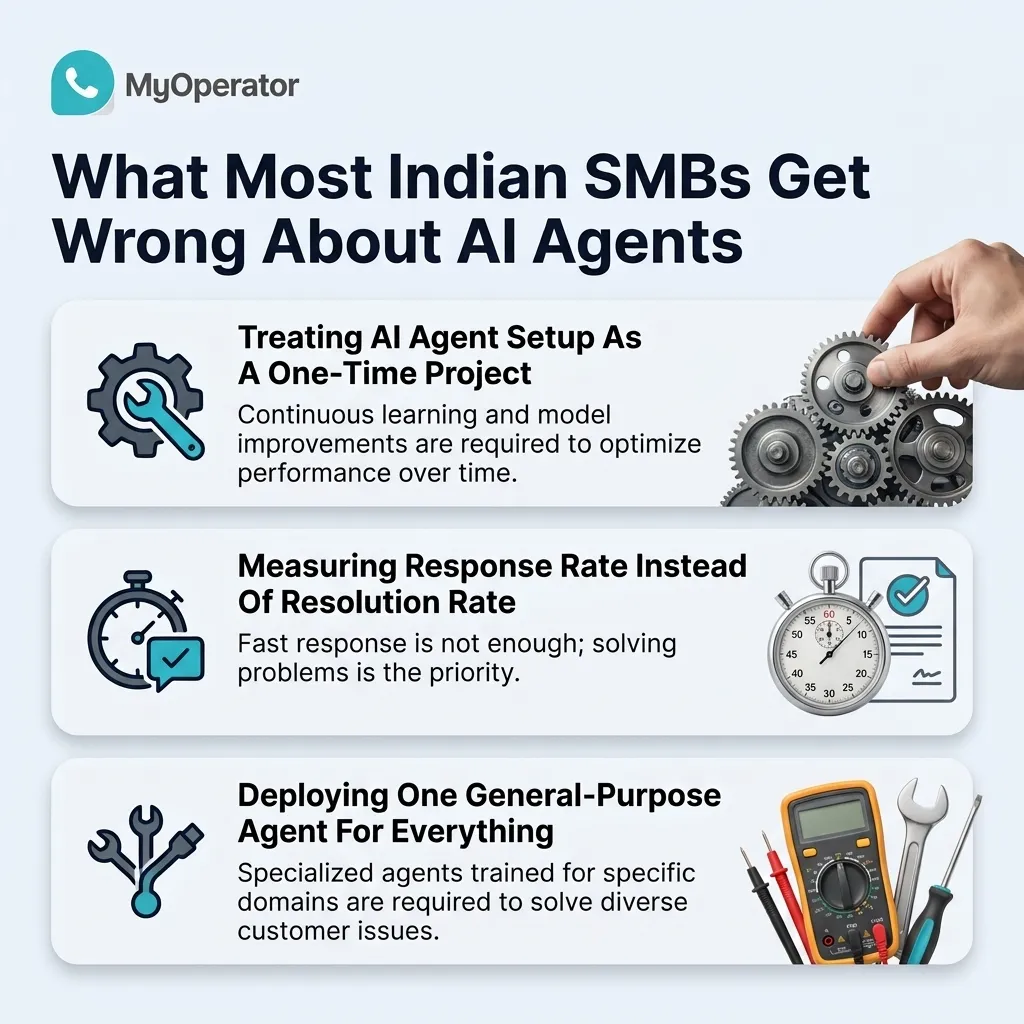
Treating AI Agent Setup As A One-Time Project
Many businesses launch an AI Agent, connect a knowledge base, and assume the work is done. In reality, AI Agents require ongoing optimization.
New products, updated pricing, policy changes, and evolving customer questions continuously reshape customer conversations. Businesses seeing the strongest results review, iterate, and improve their agent configuration regularly, while underperforming deployments remain unchanged for months.
Measuring Response Rate Instead Of Resolution Rate
A fast response is not the same as a successful outcome. An AI Agent can respond to 100% of customer queries, but can resolve only a handful of them. The most successful MyOperator AI Agents were built on measuring containment rate, resolution rate, escalation rate, and customer satisfaction to confirm the customer actually got what they needed.
Deploying One General-Purpose Agent For Everything
Most Indian SMBs start with a single AI Agent responsible for support, sales, lead qualification, bookings, and follow-ups. The highest-performing deployments take the opposite approach.
They use specialist AI Agents trained for specific workflows. Once the first agent proves successful, a second complementary agent is introduced. This is where small businesses see the largest jump in automation coverage, customer experience, and operational efficiency. Narrowly scoped AI agents consistently outperform one-size-fits-all deployments.
What 200+ AI Agent Deployments Reveal About The Future Of Indian SMBs
Across MyOperator's AI deployments, the clearest pattern is that AI Agents are not replacing teams. They are removing operational bottlenecks to empower humans to do their best work.
The Indian SMBs seeing the strongest results are not necessarily the ones with the largest AI budgets, the most advanced technology stacks, or dedicated AI teams. They are the businesses that identified repetitive customer communication workflows and delegated them to specialized, highly-trained AI Agents.
The most successful deployments also treat AI Agents as an operating capability rather than a software setup. AI agents need continuous improvement, training on new information, and expansion into adjacent workflows as the business grows.
Perhaps the most important finding is that AI adoption is no longer limited to technology companies. Across hospitality, healthcare, manufacturing, financial services, real estate, education, retail, and even religious organizations, Indian SMBs are already using AI Agents to answer calls, manage WhatsApp conversations, qualify sales-ready leads, automate customer support, and stay available around the clock.
The question is no longer whether AI Agents will be a part of business communication for Indian SMBs. They already have.
The question is, which businesses will adopt AI and build a competitive advantage?
Related reads:
- How AI Voice Agents Reduce Average Handle Time (AHT) by Up to 40%
- Will AI Voice Agents Replace Traditional Call Centers?
- AI Calling Agent for Outbound Sales: How It Works and When to Use It
- Reducing Response Times From 24 Hours to 30 Seconds With An AI Chat Agent
.webp)
.avif)



.webp)


