








Every Monday at noon, the sales team realizes that half the leads that came in over the weekend are now uninterested.
This is exactly the challenge an AI agent for outbound calling solves. The challenge with manual lead qualification is that your teams treat each prospect equally, so the high-intent leads must wait while they filter out unqualified ones.
That’s not a people problem. Without the right sales automation infrastructure, even the best sales development representatives (SDRs) struggle to prioritize the right conversations.
Without AI outbound calling, qualified leads sit idle long enough for intent to decay or competitors to engage them.
Most businesses respond by hiring more SDRs. But that treats the symptom, not the disease. More dialers don’t create more sales-ready conversations. Better qualification infrastructure does.
A calling AI agent helps businesses automate lead qualification, respond to sales inquiries instantly, and ensure teams spend more time selling instead of screening prospects.
Why Traditional Lead Qualification Slows Down Sales Teams
Before understanding how an AI agent for outbound calling works, it helps to understand where businesses create the most value with it.
Lead qualification is usually the first thing sales teams look to automate.
A prospect fills out a form. Downloads a brochure. Registers for a webinar. Requests pricing information. Then, they enter a queue. Someone from the sales team eventually reaches out. Sometimes in ten minutes. Sometimes in three hours. Sometimes the next day.
The problem is that buying intent does not wait. People forget the forms they filled out. They rarely forget conversations they started.
The longer a lead sits in a queue, the more context disappears. Interest fades. Competitors respond. Momentum is lost.
An AI calling agent can contact every lead in seconds, qualify intent, collect details, and schedule a meeting or instantly route the lead to the right salesperson. The goal is not simply to automate outreach, but to preserve intent while it still exists.
Missed call recovery is another area where businesses see immediate impact with AI calling agents. Every company loses opportunities because someone did not answer the phone at the right moment. A prospect calls during lunch, after business hours, or during peak call handling hours when agents are already busy with other conversations.
A voice AI agent calls back instantly, every single time. Appointment reminders, renewal outreach, payment reminders, dormant lead re-engagement, or post-demo follow-ups.
Every high-value conversation where consistency matters more than persuasion can be handled effectively by voice AI agents, instead of SDRs. And you see up to 21x higher qualification when you call new leads within 5 minutes vs. 30 minutes after the first interaction.
The biggest misconception about AI outbound calling is that it replaces salespeople. In reality, the opposite is true. AI handles the repetitive, while human reps handle conversations that require judgment, trust-building, objection handling, and closing. In fact, pre-qualifying leads with AI voice agents reduces the average handle time (AHT) for calls by up to 40%.
The value is that your salesperson only enters the conversation when their expertise is actually needed.
What Is An AI Calling Agent and How Does It Work?
An AI calling agent is an AI-powered voice system that can initiate, receive, and manage phone conversations without human intervention.
Unlike traditional IVR systems that rely on menu selections and keypad inputs, AI calling agents use natural language processing (NLP) to understand customer responses, ask follow-up questions, and complete tasks such as lead qualification, appointment scheduling, customer follow-ups, and call routing.
Businesses confuse calling AI agents with robocalls or IVR systems. However, the technologies serve very different purposes.
Traditional IVR systems route callers through predefined menus, while AI calling agents hold two-way conversations and take action based on customer intent.
For example, an AI calling agent can call prospects, ask qualifying questions, collect information on budget and requirements, address common objections, schedule demos, and transfer high-intent leads to sales representatives.
No, they are not perfect salespeople.
They are something more practical: always-available sales coordinators.
Unlike human teams, AI calling agents operate 24/7 and maintain consistent performance across every interaction, even on weekends, holidays, and during peak calling hours. They do not lose focus, rush through conversations, or slow down as the day progresses. Whether it’s the first call of the day or the five-hundredth, they follow the same qualification process.
This consistency makes AI calling agents particularly effective for outbound sales. Here’s how they stack up against human-only sales calling.

AI Calling Agents vs Manual Sales Calling: Where Does Sales Automation Actually Help?
The biggest misconception around AI calling agents is that they are a cost-cutting tool. Just observe how most of them are marketed:
Reduce sales headcount.
Automate lead qualification.
Replace SDRs with AI agents.
While AI automation can lower operational costs, the most successful businesses use AI calling agents to improve the sales team’s productivity rather than replace human representatives.
Think about how most of your sales reps spend their day.
A significant portion is repetitive activities, such as initial outreach, lead qualification, follow-ups, and identifying whether a prospect matches the ideal customer profile (ICP). These tasks are essential, but they are also highly structured, repetitive, and not necessarily manual work.
An AI calling agent can handle these at scale to qualify prospects based on predefined criteria and route high-intent opportunities to the sales team. This allows sales representatives to spend less time screening and more time building relationships, handling objections, and closing deals.
That is a much better use of human talent.
That is why businesses deploy AI calling agents as a qualification layer for outbound sales. The AI agents handle the repetitive tasks, while human teams focus on conversations that require experience, persuasion, and judgement. However, this often raises a question:
👉 Will AI Voice Agents Replace Traditional Call Centers?
Businesses using MyOperator's AI Voice Agent for outbound calling have successfully automated lead qualification, intent capture, and escalation of sales-ready prospects to their sales teams with complete conversation context.
Where AI Calling Agents Outperform Humans (And Where They Don't)
How AI Calling Agents Run Outbound Sales Calls End-to-End
AI calling agents need a trigger: a lead form submission, a website inquiry, a WhatsApp message, or a CRM event.
The moment that trigger occurs, the AI calling agent can place a call automatically.
From there on, it follows a qualification framework that’s designed around your sales process.
The questions are predefined.
The logic is configurable.
The outcomes are measurable.
For instance, a high-intent lead can be booked directly into an available sales representative's calendar. A prospect with budget constraints might be routed into an email nurturing sequence. A poor-fit lead may be filtered out before it reaches the sales team.
By the time a sales representative joins the conversation, they already know who the prospect is, what they are looking for, and whether they meet qualification criteria.
The result is a pipeline that arrives pre-qualified instead of pre-populated.
However, AI calling agents can only perform as well as the infrastructure supporting them.
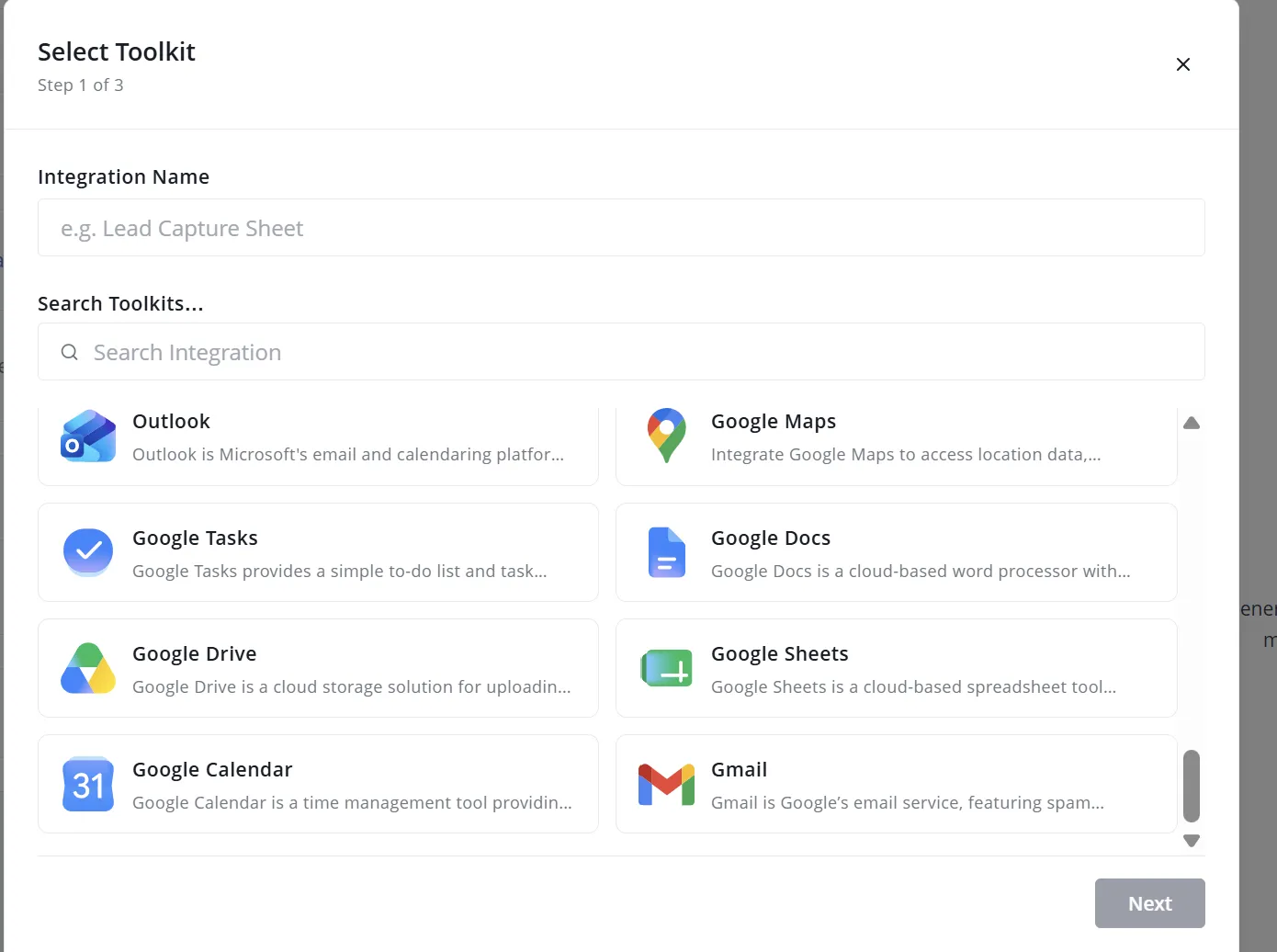
MyOperator supports integrations with CRMs, calendars, email systems, and lead management tools, allowing calling your sales AI agents to automatically update CRM records, schedule meetings, trigger follow-ups, and route qualified prospects to the right teams without manual intervention.
Voice AI Agents for Sales Automation: How to Deploy a Calling AI Agent for Indian SMBs
Indian businesses communicate differently from most global markets, and that has a direct impact on how AI calling agents need to operate. At MyOperator, we have spent 15+ years helping Indian businesses improve customer communication. One pattern shows up repeatedly: teams rarely struggle because they are not making enough calls. They struggle because too much time is spent figuring out which conversations deserve immediate attention.
A prospect may discover your business through a Meta ad, start a conversation on WhatsApp, visit the website for more information, and still expect a phone call before making a purchase decision. When the call arrives, knowing that this is a lead who's ready to convert is the difference between escalating them to a sales rep or keeping them waiting while their buying intent decays.
Plus, language adds another layer of complexity. A lead in Gujarat may prefer to speak in Gujarati. A prospect in Bengaluru may switch between English and Kannada in the same conversation.
This means multilingual voice AI agents are not nice-to-have, but vital for sales automation for Indian SMBs. It is part of the customer experience.
The same applies to business hours, lead volumes, and customer expectations. Many SMBs have relatively small teams, and scaling consistently across every sales channel becomes difficult.
This is where AI calling agents can play a valuable role in outbound sales.
MyOperator's AI Calling Agent supports all major Indian languages, which means teams can scale outbound conversations while adapting to how customers actually communicate. For Indian SMBs, the challenge is not simply handling more outbound calls. It is handling more conversations across channels, languages, and customer touchpoints.
How AI-Powered Calling Agents Are Changing Outbound Sales
AI outbound calling is not about replacing sales teams. It is about eliminating the repetitive, low-value work that requires very little judgment but quietly consumes the majority of a sales team's time.
When lead qualification runs continuously, at scale, and with consistent execution, humans can focus on what they do best. Building trust, handling complexity, and closing deals.
The question is no longer whether AI calling agents will participate in outbound sales. The real question is whether your sales team will spend most of its time qualifying leads or actually selling to them.
Because the future of outbound sales is not more activity, but more qualified activity.
MyOperator’s Voice AI agents are designed to help businesses automate lead qualification and scale their outbound sales workflows.
.avif)



.webp)


