








Most businesses evaluate an AI support chat agent on its response speed, uptime, and automation coverage. However, customers evaluate it based on one factor: whether it resolves their issue.
This is the biggest gap in today’s customer service chatbots: they can answer every inbound message but still create a poor customer experience. The problem is even more visible when customers switch between chat and calls, because a fast response means little if the issue remains unresolved when the conversation continues elsewhere.
The most successful AI customer service agents are not optimized for responses or speed, but for resolution rates, containment rates, and first-response times. They also gain customer context with voice interactions to deliver successful resolutions, no matter how the customer reaches out.
Here’s why your 24/7 AI chat agent fails to improve CSAT (and how you can optimize its performance).
Is Your 24/7 AI Chat Agent Hurting CSAT?
The marketing pitch for a conversational AI chatbot usually starts with one promise: 24/7 availability.
Never miss a customer query. Respond instantly. Eliminate after-hours support gaps.
Being available for customers around the clock is valuable, but this alone can’t improve customer satisfaction.
The best AI customer support systems are measured by how many customer issues they resolve, not how many messages they answer. This is where metrics like AI chatbot containment rate, resolution rate, and CSAT become more important than response time.
Leading enterprise AI automation platform Pega says that 46% of consumers feel AI-powered customer service rarely or never leads to a successful outcome. At the same time, 51% of consumers say they prefer interacting with AI bots over humans, specifically when they want immediate service, according to Zendesk.
Customers want speed. They are comfortable receiving fast responses from an AI chat agent. But they still expect their problem to be solved.
That expectation is where most 24/7 AI chat agents fail.
For a comprehensive breakdown on AI chat agents for businesses, click here: AI Chat Agents in India: A Complete Guide for Businesses
Most Businesses Measure Their 24/7 AI Chat Agent The Wrong Way
The argument for 24/7 availability makes sense as customers contact businesses at all hours, especially on WhatsApp. Human teams have shift constraints, but an AI chat agent for customer service can ensure every customer receives an immediate response.
The problem occurs when businesses measure the wrong metrics.
Chat automation is often considered successful if it achieves a high response rate, low first-response time, and round-the-clock availability.
Whether those responses actually solve customer problems is treated as a separate question. Because customers do not care whether an AI chatbot or a human agent responds, they care whether their query was resolved.
That is why metrics like containment rate, resolution rate, and CSAT matter far more than response rate alone. A chat agent that replies to every customer message but resolves only a small percentage of issues can still create a poor customer experience.
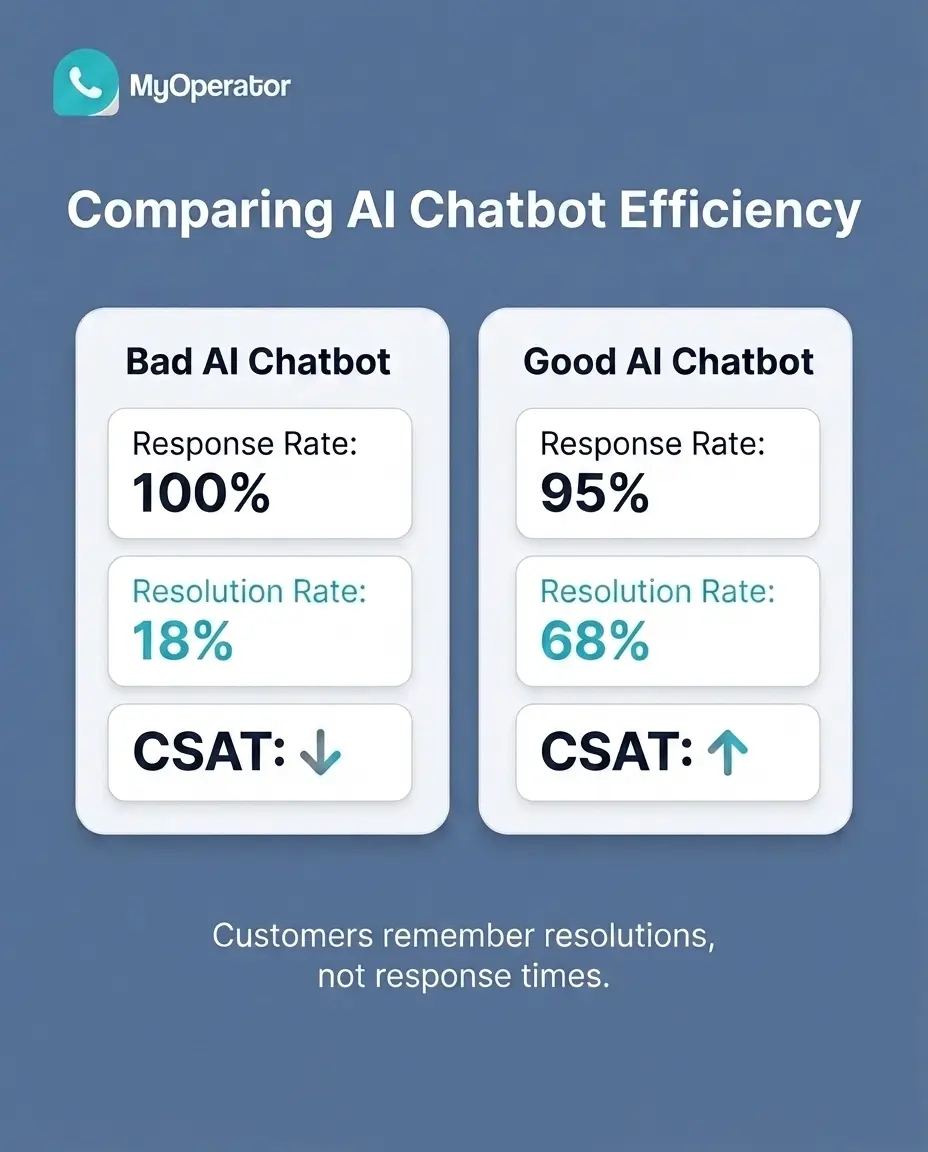
The gap between "using AI chatbots" and "AI chat agents that resolve" is why most AI deployments stall.
This is also where the distinction between AI chatbots and AI chat agents becomes important. Traditional AI chatbots are designed to respond. AI chat agents are designed to resolve. Instead of measuring success by whether a reply was sent, they are built around outcomes such as issue resolution, successful escalation, and customer satisfaction.
So, what should you actually measure to improve CSAT and customer experiences?
What Customers Actually Want From A 24/7 AI Chat Agent
Customers value instant replies. They are increasingly comfortable interacting with AI chatbots for routine questions and simple requests. Yet, Gartner reports that even with issues customers considered “very simple,” the resolution rate was just 36%.
What customers value the most is resolution.
When customers reach out to a business, they are looking for an answer, an update, a booking confirmation, a refund status, or a solution to a problem.
Customer satisfaction data consistently points to the same hierarchy of needs: resolution first, speed second, accuracy third, consistency fourth, and availability last.
- Resolution matters most as unanswered queries remain a problem, regardless of how quickly a chatbot replies.
- Speed matters next because customers expect immediate acknowledgment and progress, especially on channels like WhatsApp.
- Accuracy comes next, as a fast but incorrect answer creates more frustration than a delayed but correct one.
- Consistency becomes important because every customer should get the same answer regardless of when they ask or how they phrase the question.
The AI Chatbot Metrics That Often Hide Poor CSAT
Businesses often track metrics that make their AI chatbot look successful.
However, customers are far more likely to remember whether their issue was resolved than how quickly the chatbot replied or how detailed the response was.
An AI chatbot that is available 24/7 but resolves nothing delivers availability without the value that makes it useful.
What A Resolution-First 24/7 AI Chatbot Looks Like
The strongest AI customer support deployments share a common characteristic: they are designed around resolution, not availability. Instead of treating chat and voice as separate workflows, resolution-first AI agents help businesses maintain customer context as conversations move between channels.
MyOperator's AI Chat Agent is built for businesses that need a 24/7 AI chatbot capable of resolving customer queries at scale across WhatsApp and calls. Instead of functioning as a standalone FAQ bot, it operates as an AI-powered extension of your customer support team.
This is particularly important because customer support issues begin on chat but are ultimately resolved on a call with a human or a Voice AI Agent. Resolution depends on context and continuity, not just 24/7 availability.
With MyOperator's AI Chat Agent, businesses can:
- Resolve routine customer queries using your business knowledge base
- Escalate complex or sensitive issues to human agents automatically
- Transfer conversations with full chat history and customer context intact
- Integrate with CRM and support workflows to avoid disconnected customer experiences
- Track containment rate, resolution rate, and CSAT alongside response metrics
By combining AI customer support automation across calls and chat with seamless human handoff, MyOperator helps businesses maintain 24/7 availability without sacrificing customer experience or satisfaction.
Routine support interactions are handled instantly by AI agents, while ensuring customers can always reach a human agent when required.
How To Build A High-CSAT Customer Support AI Agent: 5 Proven Principles
#1. Design for resolution, not responses
Before deploying a 24/7 AI chatbot for customer service, identify the most common queries your team handles and confirm the AI can genuinely resolve them across different scenarios. A fast response is only valuable if it moves the customer closer to a resolution.
#2. Build escalation paths before launch
Every AI customer support workflow should have clear fallback logic. When the AI cannot help, it should create a ticket, route the conversation to the right team, and provide realistic expectations for the next step.
#3. Measure containment rate with CSAT
Response rates tell you whether the chat agent replied. Containment rates tell you if it handled the conversation without human intervention. CSAT tells you whether the customer felt the interaction was successful. The strongest AI customer support teams track all three together.
#4. Continuously improve using unresolved conversations
Every escalation, failed answer, or repeated customer question is training data. High-performing AI customer support systems evolve based on real customer interactions rather than remaining static after deployment.
#5. Escalate for empathy, not just complexity
Customers asking about billing disputes, service failures, or urgent issues often need human judgment, not another automated answer. A well-designed AI support agent recognizes frustration signals and brings in a human before customer satisfaction declines.

The Real Question To Ask About A 24/7 AI Chatbot
A 24/7 AI chatbot is a customer expectation. However, the real differentiator is whether that AI chatbot can resolve issues, maintain context, and know when to involve a human.
Businesses evaluating AI customer support should spend less time asking whether a chatbot can respond around the clock and more time asking about its containment rate, resolution rate, and CSAT.
The best 24/7 AI chatbots are not measured by how often they answer. They are measured by the customer resolutions they deliver.
Related Reads:
How to Create a WhatsApp Chatbot in 2026, Step-by-Step Guide
WhatsApp AI Chatbots for Lead Generation: What They Actually Do (And What They Don't)
AI Chat Agents in India: A Complete Guide for Businesses
.avif)



.webp)


