








Every major shift in customer communication has raised the same fear: "Will technology replace people?"
AI voice agents are the latest example. They answer calls instantly, resolve routine conversations, and operate around the clock. Naturally, businesses are asking whether traditional call centers still have a role.
The better question isn't whether AI replaces call centers. It's what the AI-powered call centers look like.
AI voice agents already handle routine customer conversations, with enterprises automating up to 80% of repetitive customer queries using conversational AI systems. Some brands are using AI voice agents to automate their front desk and replace traditional IVR systems for inbound call handling.
Modern AI call center software automates customer conversations at scale with voice-based AI call center agents, reducing wait times, streamlining FAQ support, qualifying inbound leads, and supporting human agents with real-time assistance.
But there’s a lot that voice AI agents for call centers cannot automate. Here’s what AI call centers actually change.
How Businesses Use AI Voice Agents For Call Center Automation In 2026
AI voice agents can answer inbound calls 24/7, capture intent, resolve queries, and route complex cases to humans, across 500 calls at once, without taking a break.
At MyOperator, we analyzed 300+ AI agent deployments to understand what actually changes. For the complete report, head here: How Indian SMBs Are Using AI Agents in 2026: Findings From 300+ MyOperator Deployments
Coming back to the question: its not whether conversational AI agents can do what call centers do. (They can, at much lower cost and higher reliability).
The real question is whether conversational AI in call centers will replace traditional call centers. And if yes, what does it means for your customer communication infrastructure in 2026 and beyond?
The State Of Enterprise AI Adoption In 2026
Organizations today operate at one of three tiers of voice AI deployment:
Tier 1: AI IVR For Smart Resolutions
AI voice agents replace dial-tone menus (DTMF) with natural speech. Instead of relying on IVR systems, customers say what they need, leading to instant resolutions, faster call routing, and lower call abandonment. This is the fastest and easiest way for businesses to deploy AI agents.
Tier 2: AI Voicebots For Customer Conversations
Advanced voice AI agents handle calls end-to-end for defined use cases, such as appointment booking, checking account status, FAQs, and password resets. No human involvement is required. This is when interactions shift from AI-assisted to AI-led customer conversations.
Tier 3: Conversational AI Agents For Call Centers
Conversational AI agents work with human teams to provide real-time responses, pull CRM context mid-call, summarize conversations post-call, and escalate exceptions with full context. The human agent is still on call, but they’re no longer doing the grunt work.
Most call center operations in 2026 are at Tier 1 or early Tier 2. However, businesses gaining a competitive edge are those moving toward Tier 3.
Here’s why AI + human call handling matters for legacy call center operations.
.webp)
Where Human Call Center Agents Still Outperform AI Voice Agents
Most Voice AI vendors will not mention this, but AI calling agents are exceptional at structured, repeatable, high-volume interactions.
They are not, and likely will not be in the near term, equipped to handle:
- Conversations where the emotional stakes are high, such as a customer dealing with a loss or a complaint that has already escalated twice.
- Situations where judgment is required beyond the scope of configured workflows, such as edge cases, policy exceptions, or complaints with no precedent.
- Conversations based on human relationships, like that between an account manager and a customer, that are built over years.
The distinction matters for businesses worried about AI replacing their 1,000-seat call center overnight.
The routine, predictable, high-volume tier of your call center operations is automatable. In teams heavily automating Tier-1 support, organizations report reduced staffing requirements by 20–30%, according to JustCall. This doesn’t mean replacement; simply that roles shift upward toward escalations, relationship and retention management, and complex issue resolution.
The human aspect of your operations cannot be replaced or automated even today. This means that AI contact centers are not a replacement for human-led calling.
How AI Changes the Modern Call Center
Today, conversational AI call center technology can automate up to 80% of customer conversations across support and sales operations.
So, what happens to businesses relying on human-led call center workflows while competitors automate first responses, after-hours coverage, and low-level query resolution?
Those businesses get outpaced by contact centers delivering faster response times through always-on customer engagement.
Here’s a look at the difference between a voice AI-powered call center and a traditional call center:
For businesses still relying on traditional human-only call handling, the gap is a significant competitive disadvantage.
Why Call Centers Are Upgrading To AI Voice Agents
A traditional call center budget cannot afford to scale headcount beyond a certain limit. With AI voice agents, however, call center economics have changed. Businesses that don’t change with time will find themselves lagging their AI-friendly competitors.
Benefits Of AI Voice Agents For Call Center Teams
- Reduce average handle time (AHT) with faster intent detection
- Automate repetitive inbound calls like FAQs, bookings, and status checks
- Lower support costs by reducing manual call handling
- Reduce missed calls with 24/7 AI voice support
- Improve after-hours customer response times
- Support multilingual customer conversations at scale
- Scale support operations without increasing headcount
👉 The First Step Of Modernizing Call Centers With AI: Switching to AI-powered IVR
Business Impact Of AI Voice Agents On Traditional Call Centers
Businesses that transition in 2026 are not just reducing call center costs but compounding their AI advantage.
Every day of AI deployment improves resolution accuracy, reduces the escalation rate, and builds a better-trained AI voice response system. The numbers speak for themselves.
Legacy Call Centers vs AI Call Centers: What The Data Shows
- AI-powered call centers see up to 70% lower interaction costs.
- AI call center agents achieve first-call resolution rates of 85-95% compared to 65-75% for traditional call center operations.
- Enterprises adopting AI voice agents see 20-40% lower agent workloads within 12-18 months.
- AI voice systems reduce average handle time (AHT) by up to 40% by automating verification, routing, and data capture.
👉 See Your Potential Cost Savings: Up To 40% Lower Average Handle Time (AHT) For Calls
How To Integrate AI Voice Agents With Existing Call Centers
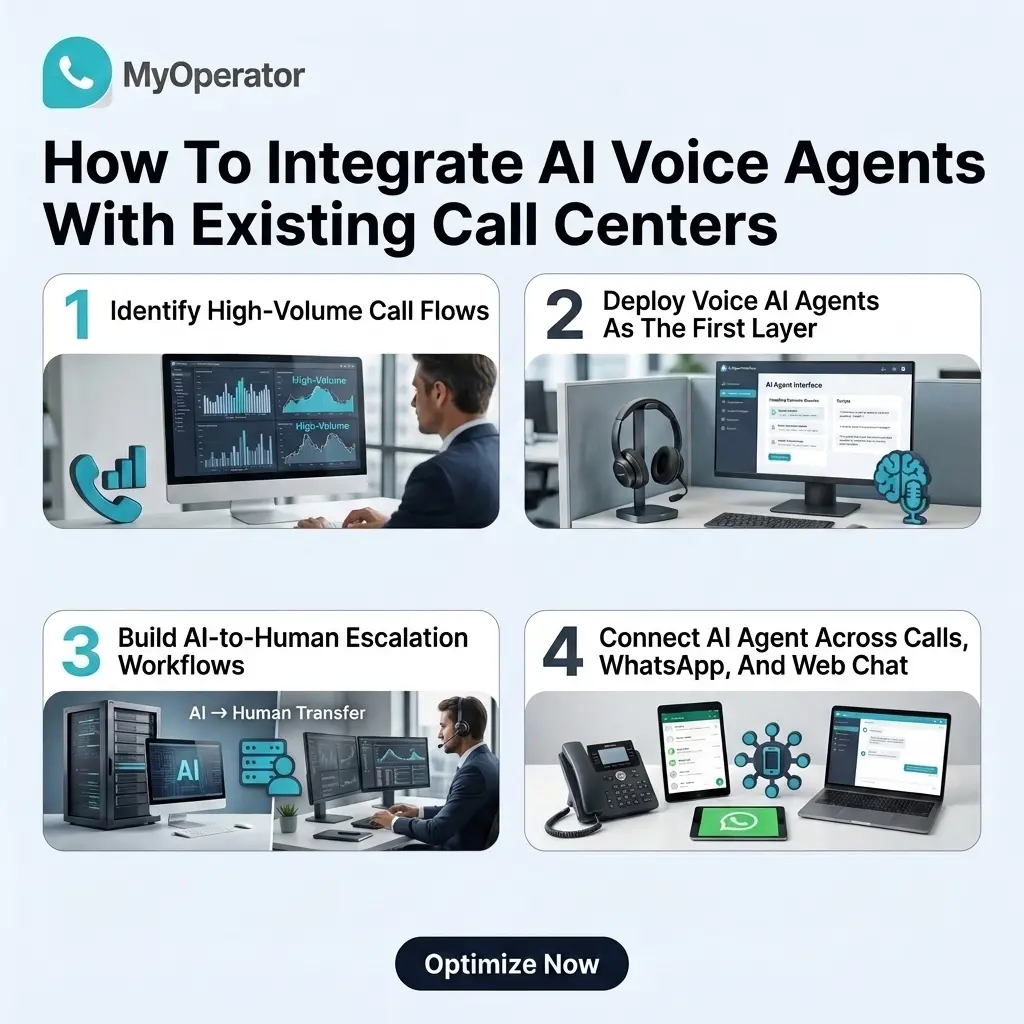
The transition from a traditional call center to an AI-augmented calling operation is not a one-off project. It is a layering exercise that takes months.
Modern AI voice agent software integrates with existing IVR systems, CRMs, support workflows, and business phone infrastructure without replacing your current setup.
So, your existing business and existing team stay the same. What changes is the first layer of every inbound call.
Step 1: Identify High-Volume, Repetitive Call Flows
Start with conversations that are:
- High-frequency and repetitive
- Structured and workflow-driven
- Dependent on scripts or IVR menus
Typical use cases for AI voice automation include:
- Appointment booking
- Order status checks
- Payment reminders
- FAQ resolution
- Lead qualification
- Customer verification
- Basic support requests
These are the fastest workflows to automate successfully with AI systems.
Step 2: Deploy Voice AI Agents As The First Layer
AI voice agents can answer inbound calls instantly, understand spoken intent, tailor responses using CRM context, resolve queries autonomously, and route calls intelligently to teams.
This immediately reduces hold times, missed calls, and repetitive agent call center workload.
Step 3: Build AI-to-Human Escalation Workflows
The goal is not full automation, but ensuring human agents only handle conversations where:
- Expert judgment is required
- Emotional sensitivity matters
- Exceptions or escalations occur
- Revenue opportunities depend on human persuasion
Your AI voice agent should transfer such conversations to human agents with:
- Call transcripts
- Customer history
- Intent data
- CRM context
- Conversation summaries
This eliminates context repetition for customers and agents alike.
Step 4: Deploy AI Voice Agent Across Channels
Customers no longer communicate on a single channel. Modern voice AI interactions happen at various touchpoints, so you team should have conversational context across such channels:
- Voice calls
- WhatsApp conversations
- Website chat
- CRM systems
- Support tickets
How MyOperator Helps Call Centers Deploy AI Voice Agents
Most AI voice platforms focus on the conversation layer. But in call center environments, AI agents are only as effective as the telephony infrastructure they run on.
Effective voice AI deployments factor in latency, routing and escalation logic, CRM sync, omnichannel context, call reliability, and human handover workflows. That is where MyOperator is fundamentally different.
MyOperator’s AI Suite operates on the legacy cloud telephony stack that powers communication workflows for 12,000+ businesses. Instead of layering AI agents onto third-party systems, MyOperator combines the infrastructure layer and the AI layer into a single, unified operational stack. That means businesses modernize their call center without stitching together multiple vendors. Connected with cloud telephony, IVR, WhatsApp, routing systems, and CRM, so you can build connected workflows.
MyOperator’s always-on AI agents for calls can:
- Answer every call instantly, 24/7
- Understand intent from natural speech
- Refer to the CRM context mid-call to personalize responses
- Resolve Tier 1 and Tier 2 queries autonomously
- Transfer complex cases to human agents with full context
Businesses can deploy conversational AI voice workflows on calls, WhatsApp, and web chat while retaining full human escalation control and omnichannel conversation context.
So, your call center agent who previously spent 60-80% of their shift handling routine queries can now spend that same time on conversations that require empathy, building user trust, and long-lasting connections.
That is not a replacement, but an elevation of customer experience.
👉 Evaluating AI Voice Agents For Your Business? Explore The Top 10 Voice AI Agents in India (2026)
The Future Of AI Voice Agents And Call Centers
The question you must ask is this: at what point does not deploying AI voice agents become a competitive disadvantage for my call center operations?
The future isn't AI replacing call centers. It's AI agents redefining what a call center does.
The concept of call centers is not going away. But call centers that rely exclusively on human agents to handle every interaction manually are already being upgraded.
What remains is the version that is smarter: a hybrid system where AI handles the volume, humans handle the judgment, and every customer gets a faster, better answer regardless of when they call.
.webp)
.avif)



.webp)


