








"Press 1 for Sales. Press 2 for Support."
Most of us have heard some version of this while calling a business. Traditional IVR systems have helped companies manage incoming calls for years by routing customers to the appropriate department. But as customer expectations have evolved, these voice menu-driven experiences are beginning to show their limitations.
Today's callers expect businesses to understand why they are calling, respond naturally, and help them resolve their issues quickly. They don't want to navigate multiple options, repeat information, or be transferred from one department to another.
This is where AI voice agents are changing the conversation.
While the terms AI voice agent, AI bot, AI chatbot, and AI IVR are often used interchangeably, they represent very different technologies with different capabilities. Understanding those differences is essential for businesses evaluating how to improve customer communication.
This blog explains what an AI voice agent is, how it differs from traditional bots, chatbots, and IVR systems, and when businesses in India should consider using one.
What Is An AI Voice Agent?
An AI voice agent is an AI-powered virtual assistant that can answer phone calls, understand spoken language, interpret customer intent, and complete business tasks through natural conversations.
Unlike traditional IVR systems that rely on keypad inputs or fixed call flows, AI voice agents allow customers to speak naturally. Instead of navigating menus, callers can explain what they need in their own words.
An AI-powered voice agent processes the conversation, determines the customer's intent, and responds appropriately. Depending on the business workflow, it can answer questions, qualify inquiries, schedule appointments, collect information, update CRM records, transfer calls to the appropriate team, or escalate the conversation to a human representative when necessary.
The objective is not to automate phone answering, but to make every customer conversation faster, more accurate, and easier to complete.
Today, businesses use AI voice agents across sales, customer support, appointment booking, lead qualification, after-hours call handling, collections, and customer follow-ups.
What Can an AI Voice Agent Do?
An AI voice agent can support a wide range of customer interactions, including:
- Answering inbound business calls
- Qualifying leads before transferring them to sales
- Booking appointments and consultations
- Handling frequently asked questions (FAQs)
- Routing callers based on their intent
- Collecting customer information
- Creating or updating CRM records
- Escalating complex support conversations to human agents
- Providing 24/7 call handling
As call volumes grow, these capabilities help businesses reduce missed opportunities while allowing teams to focus on higher-value conversations.
Here’s what changes when you upgrade from an IVR system, an AI bot, or an AI-powered chat bot.
AI Voice Agent vs Traditional IVR
An AI voice agent and a traditional IVR solve different problems.
A traditional IVR is designed to guide callers through predefined menu options. Every conversation follows a fixed path based on keypad selections or simple voice commands.
An AI voice agent is designed to understand the purpose of the conversation itself. Rather than asking customers to navigate menus, it listens, identifies intent, and responds naturally.For straightforward routing, a traditional IVR may be sufficient. However, businesses looking to improve customer experience, reduce abandoned calls, and automate more complex conversations typically require capabilities beyond a conventional IVR.
AI Voice Agent vs AI Bot
The word bot is often used as a catch-all term for any automated software, which creates confusion.
In reality, an AI voice agent is one type of AI bot, but not every bot is an AI voice agent.
Traditional bots are usually designed to complete a single task by following predefined rules. They work well when interactions are predictable, but they struggle when customers ask unexpected questions or change the direction of a conversation.
AI voice agents are built to handle conversations rather than commands. They can understand context, ask follow-up questions, adapt their responses, and continue the interaction without relying entirely on scripted flows.
Think of it this way:
- A rule-based bot follows instructions.
- An AI voice agent understands conversations.
This difference becomes especially important in customer-facing roles where conversations rarely follow a fixed script.
Consider how Swami Rupeshwaranand Ashram handled customer enquiries before adopting conversational AI. Volunteers spent 70–80% of their day answering repetitive questions about pricing, availability, and bookings, while quote responses often took 24–48 hours. After deploying MyOperator's AI-powered solution, response times dropped to 30 seconds, and only pre-qualified enquiries reached the team. Rather than following rigid decision trees, the AI could understand customer requirements, gather relevant information, and move conversations toward a meaningful outcome.
AI Voice Agent vs Chatbot
One of the most common misconceptions is that an AI voice agent and an AI chatbot are the same technology.
While both use artificial intelligence to interact with customers, they are designed for different communication channels and customer experiences.
A chatbot operates primarily through text. Customers interact with it on websites, mobile apps, WhatsApp, or other messaging platforms by typing their questions and receiving written responses.
An AI voice agent, on the other hand, communicates through phone calls. Instead of reading text, it listens to spoken language, understands customer intent, and responds naturally through voice.
The distinction matters because not every customer prefers the same channel. A customer checking an order status may be comfortable using a chatbot, while someone discussing loan eligibility, booking a medical appointment, or requesting product pricing often prefers speaking to a business.
Rather than replacing chatbots, AI voice agents complement them by extending conversational AI to voice-based interactions.
For businesses, the decision is rarely about choosing one over the other. Many organisations use chatbots for digital conversations and AI voice agents to manage phone calls, creating a more consistent customer experience across channels.
How Does an AI Voice Agent Work?
Despite sounding conversational, an AI voice agent follows a structured process behind the scenes.
Instead of relying on fixed menus or scripted responses, it analyses each conversation in real time before deciding how to respond.
A typical interaction looks like this:
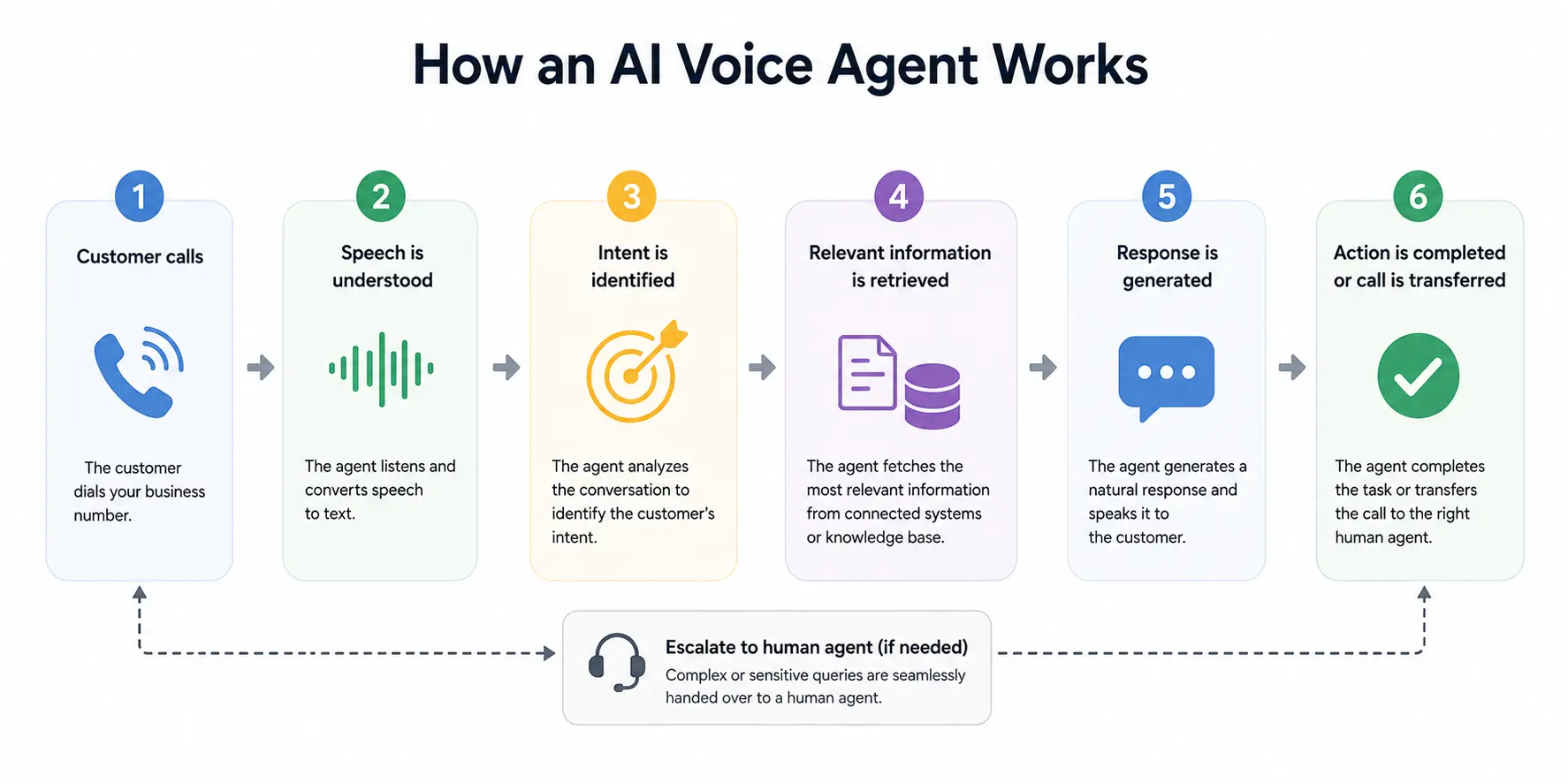
The diagram above illustrates the typical flow of an AI voice agent, from understanding a customer's request to retrieving relevant information, generating a response, and escalating the conversation to a human agent when necessary.
Behind this workflow, several AI technologies work together:
- Speech recognition converts spoken words into text.
- Natural language understanding (NLU) identifies what the customer is trying to achieve.
- Business logic determines the next action based on your workflows.
- Knowledge retrieval pulls relevant information from connected systems.
- Natural language generation produces a conversational response.
- Human escalation transfers the call whenever the AI encounters a request that requires human expertise.
Because every conversation is analyzed in context, AI voice agents can ask follow-up questions, adapt to changing customer requests, and maintain a more natural flow than traditional menu-driven systems.
Why Indian Businesses Are Adopting AI Voice Agents
The demand for AI voice agents is growing globally, but several factors make the technology particularly relevant for Indian businesses.
In many industries, customers still prefer calling before making an important decision. Whether booking a medical appointment, enquiring about a property, requesting admission information, or confirming product availability, a phone conversation often builds confidence in ways that websites and forms cannot.
At the same time, businesses face increasing pressure to respond faster without significantly increasing support teams.
An AI voice agent helps bridge that gap by answering calls instantly, handling routine enquiries, qualifying leads, and routing customers to the appropriate team when human intervention is required.
It also helps businesses deliver a more consistent experience across locations, working hours, and customer volumes.
For growing businesses, the objective is not to replace employees. It is to ensure that every customer receives timely assistance while allowing human teams to focus on conversations where they add the greatest value.
If a rule-based bot isn't cutting it for your business, and you're actively exploring AI agents, compare the best AI voice agents in India on language depth, pricing, deployment speed, human handoff, and data compliance here: Best Voice AI Agents in India (2026): Top 10 Platforms Compared
AI Voice Agent For Businesses: Top Use Cases And Benefits
AI voice agents are flexible enough to support a wide range of customer-facing workflows. Some of the most common use cases include:
Lead Qualification
Collect customer information, understand requirements, and qualify enquiries before transferring them to sales teams.
Appointment Booking
Schedule consultations, medical appointments, demos, or service visits without requiring manual intervention.
Customer Support
Answer frequently asked questions, provide order updates, and guide customers through common support requests.
After-Hours Call Handling
Respond to customer enquiries outside business hours instead of leaving a voicemail.
Call Routing
Understand why customers are calling and transfer them to the most appropriate team based on intent rather than menu selections.
Collections And Payment Reminders
Automate payment reminders and follow-up conversations while maintaining a consistent customer experience.
For businesses, adopting an AI voice agent is not simply about automating calls. It is about improving how customer conversations are handled from the first interaction.
Some of the key benefits include:
- Faster response times with instant call answering
- Reduced call abandonment through conversational interactions
- Improved lead qualification and routing
- Consistent customer experiences across every call
- 24/7 availability without expanding support teams
- Seamless integration with CRM and business applications
- Intelligent escalation to human agents whenever required
Unlike traditional automation, AI voice agents are designed to support business outcomes, helping organizations improve customer satisfaction while making better use of their existing teams.
Why Businesses Choose MyOperator's AI Voice Agent
Choosing an AI voice agent is not simply about adding another automation tool. It is about selecting a platform that can fit into your existing communication workflows while delivering a reliable customer experience at scale.
Built on more than 15 years of expertise in optimizing customer communications for 12,000+ businesses, MyOperator's AI Voice Agent combines conversational AI with the call-routing reliability, telephony infrastructure, and business integrations that thousands of Indian businesses already rely on.
Instead of replacing your existing communication stack, it adds an intelligent layer that can answer calls, qualify enquiries, book appointments, update CRM records, and seamlessly transfer conversations to human teams whenever required.
Whether you're handling inbound sales enquiries, customer support, or after-hours calls, MyOperator AI Agents ensure every customer call is answered, understood, and moved to the right outcome, without increasing team size or compromising customer experience.
.webp)
Why You Need An AI Voice Agent And Not An AI Bot
An AI voice agent is more than an automated answering system. It is designed to understand customer intent, manage conversations naturally, and help businesses respond faster without compromising the customer experience.
As customer expectations continue to evolve, businesses that invest in conversational AI will be better positioned to capture more opportunities, improve operational efficiency, and build stronger customer relationships.
Whether you're looking to automate inbound enquiries, qualify leads, or improve customer support, MyOperator's AI Voice Agent helps you deliver faster, more natural conversations at scale.
Understanding the difference between an AI voice agent and a traditional bot is only the first step. The real value comes from seeing how conversational AI can automate customer interactions, improve response times, and help your team focus on higher-value conversations.
Explore MyOperator's AI Voice Agent to see how conversational AI can help your business answer every call, qualify every opportunity, and improve customer experiences.

.avif)



.webp)


