








If you run a business that makes or receives customer calls at scale, someone has probably told you that you might need a VNO license. It is one of those phrases that sounds official enough to worry about and vague enough to be hard to check.
Most businesses using IVR, cloud telephony, or a voice AI agent do not need a VNO license. The authorisation exists for a specific kind of company: one that sells telecom connectivity to the public. Building a calling product on top of a licensed operator does not need a VNO license.
The complication is timing. In June 2026, the government replaced the framework this license used to sit under, so a lot of what you will read online describes rules that no longer apply the way they once did.
This guide explains what a VNO license is under the current 2026 rules, who genuinely needs one, what a VNO license costs today, and where IVR, voice AI agents, and branded calling sit within the VNO licensing framework, in plain terms a business owner can act on.
VNO License in India (2026): Why Most Guides Are Already Outdated
People still search for “VNO license,” and they are right to. It is the term the market uses, and it points to a real thing. But the official vocabulary has moved.
Under the framework that ran for over a decade, a UL VNO (Unified Licence – Virtual Network Operator) is signed as an agreement with the Department of Telecommunications. As of 23 June 2026, that agreement model is gone. VNO now exists as a category of authorisation under a new rulebook, which this blog covers.
The honest answer to "do I need a VNO license in India" has two parts: the concept is real but the rules behind it changed in June 2026. Most articles still describe a process that no longer exists for new applicants. This guide uses "VNO license" throughout because that is what you are searching for, and flags where the current official term is "authorisation."
What Is a Virtual Network Operator (VNO)?
A Virtual Network Operator (VNO) provides telecom services to customers without owning the underlying network it runs on.
The word doing the work is “virtual.” A traditional operator owns towers, spectrum, switches, and cables. A VNO owns none of that. It contracts with a licensed network operator, uses that operator’s infrastructure, and packages the service under its own brand and customer relationship.
A useful way to picture it: the network operator builds and runs the road, and the VNO runs a bus service on that road. The bus company sets its routes, sells the tickets, and owns the passenger relationship, but it does not lay the tarmac.
Under the current rules, the operator that owns and runs the network is a Network Service Operator, and the VNO rides on that parent NSO’s network to deliver the service. What a VNO can offer depends on the specific authorisation it holds, from voice access in a regional circle to internet service or long-distance calling.
What is a VNO License And What Does It Permit?
A VNO license is the government’s permission to sell a defined telecom service to the public over a parent operator’s network. The Department of Telecommunications grants it under the Telecommunications Act, 2023; TRAI regulates the sector and sets tariff and consumer rules, but it does not grant the authorisation itself.
The permission matters because providing a telecom service to the public is a regulated activity. It carries obligations around lawful interception, subscriber verification, data localization, and security that apply whether you own the network or ride on someone else’s.
This is also the line that separates a VNO from a software company that uses telecom infrastructure. Selling a calling service to the public, with numbers and connectivity as the product, can require authorisation. Building software that sits on top of a licensed operator’s service usually does not. This guide makes that distinction clear, so you know which side of the line you operate on.
How a VNO Works: The Layers Behind a Business Call
A single business call passes through more layers than most buyers ever see. Separating them is the clearest way to understand where a VNO sits and where it does not.
A simplified path looks like this:
- The customer places or receives a call.
- A communication platform or application handles the experience: the IVR menu, the routing logic, the recording, or the voice AI agent.
- A VNO or service provider packages and sells the connectivity.
- The parent network operator (NSO) owns the actual telecom network the call runs on.
- The call reaches the person on the other end.
The VNO layer is about who is authorised to provide the connectivity as a service. The infrastructure underneath belongs to the NSO. The software on top, the IVR and the AI, is a different layer again, and it is where most business communication products actually live. A company can build sophisticated calling software without ever touching the VNO layer, because it buys the connectivity from someone authorised to provide it.
Who Needs a VNO License, and Who Does Not
The deciding question is not “do I work with phone calls?” It is “am I providing the telecom service to the public, or am I building on top of a service someone else provides?”
A business needs a VNO or other telecom authorisation when it sells the connectivity itself: acting as a virtual operator, reselling voice or data service to the public under its own brand, or providing service that requires it to hold telecom resources directly.
A business generally does not need a VNO license when it builds software or services on top of a licensed operator. That covers most cloud telephony, IVR, CPaaS, and voice AI companies, and almost every enterprise that simply uses a calling platform to run its own operations.
Many of these companies instead operate as an Other Service Provider. An OSP uses telecom resources taken from authorised operators to deliver IT-enabled services such as call centres, and by definition it cannot provide switched telephony of its own. Following reforms that began in 2020, requirements for domestic OSPs were substantially eased, and much routine call-centre and cloud-communication activity no longer carries the registration burden it once did.
This table defines which of the 7 categories your business falls under:
This table is a simplified guide, not legal advice. The exact authorisation depends on the specific service, service area, and architecture. Confirm your position with a telecom advisor or the DoT before relying on it.
IVR, Voice AI, and Branded Calling: Where the Line Sits
Three modern voice technologies often get tangled up with VNO licensing. Each sits on a different layer.
Does Deploying an IVR System Require a VNO License?
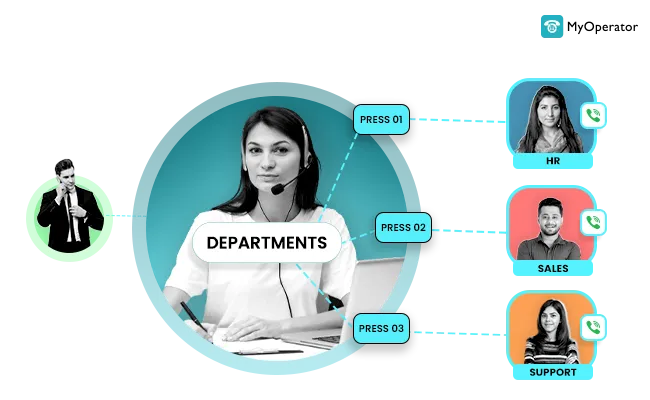
An IVR is the automated menu that answers a call and routes it. On its own, an IVR is software. Whether any telecom authorisation is involved depends on the connectivity underneath it. A business running an IVR through a cloud telephony provider uses a service built on a licensed operator, and does not need a VNO license simply by having an IVR system.
Does Deploying a Voice AI Agent Require a VNO License?
A voice AI agent adds an intelligent conversational layer on top of telephony. It understands what a caller says, responds, and takes action. That is a software capability that sits above the telephony layer, which in turn sits above the network layer.
Deploying one does not make a company a VNO, because the AI is not the telecom service. Businesses deploying MyOperator's AI Voice Agent, or any voice AI platform built on licensed cloud telephony, are not providing a telecom service to the public. They are using one. The VNO authorisation sits with the operator whose network the calls run on, not with the business that deploys the AI on top of it.
Does Deploying Branded Calling Require a VNO License?
Branded calling is where careful separation matters most, because several distinct things get lumped together. Caller ID shows a number. Calling Name Presentation, or CNAP, is a network feature that shows a verified name drawn from the operator’s own KYC records; TRAI approved its introduction in October 2025, with rollout across Indian networks progressing through 2026. Branded calling more broadly refers to displaying a business identity on a call.
These are related but legally distinct from VNO licensing. CNAP is delivered by the telecom operators from their subscriber databases, not by holding a VNO license. Number hosting and telecom authorisation are separate concepts. If a vendor implies that a VNO license is what gives you a branded call, treat that as a prompt to ask exactly which mechanism they mean.
VNO ISP License: What the Term Means in 2026
“VNO ISP license” shows up often in search results, and it is worth being clear about what it does and does not mean.
It is not a single official category, but two ideas clubbed together: the VNO model and internet service. Under the old framework, a VNO could hold an authorisation to provide internet service, riding on a parent ISP’s network.
Under the 2026 rules, internet service is one of the five principal authorisations, and can be held by either a Network Service Operator or a Virtual Network Operator. So the accurate current phrasing is a VNO holding an internet service authorisation, rather than a distinct “VNO ISP license.” The concept survives, but the label is a market shorthand rather than an official term.
VNO License Cost in India 2026: Entry Fees, Guarantees, and Net Worth Requirements
VNO license fees depend on which service you are authorised for, how wide an area you cover, and your minimum financial guarantee. They are set out in Schedule A of the 2026 Rules.
Figures from Schedule A to the Telecommunications (Authorisation for Provision of Principal Telecommunication Services) Rules, 2026 (G.S.R. 513(E)). A processing fee also applies, ₹1 lakh for the national unified authorisation and ₹10,000 for the others. Concessional entry fees apply in the North East and Jammu & Kashmir. The Gazette text remains the controlling source.
Two points matter more than any single figure.
Government fees are not the same as the cost of the business. The entry fee, processing fee, and initial guarantee are what you pay the government. The real cost of operating as a VNO also includes the equity and net-worth thresholds shown above, the ongoing authorisation fee of 8% of adjusted gross revenue, and the commercial cost of the parent operator’s network. Treating the entry fee as the price of entry substantially understates it.
These figures are current as of the 2026 Rules and lower than before. The national unified VNO entry fee fell from ₹7.5 crore under the old framework to ₹3 crore. If you are quoted a higher figure elsewhere, it is likely describing the pre-2026 regime from an outdated source.
How VNO Licensing Changed in June 2026: UL-VNO vs New VNO
This is the distinction most content gets wrong, because it was written before the change or has not been updated since.
For over a decade, telecom services ran on licences granted under the Indian Telegraph Act, 1885, organised around the Unified Licence and, for virtual operators, the UL-VNO. On 23 June 2026, the government notified the Telecommunications (Authorisation for Provision of Principal Telecommunication Services) Rules, 2026, published in the Gazette on 24 June, which replaced that licensing regime with an authorisation framework under the Telecommunications Act, 2023.
The change is structural, not cosmetic. Instead of signing a licence agreement with the Department of Telecommunications (DoT), an applicant now applies through the Telecom eServices Portal, receives a letter of intent, and is granted a non-exclusive authorisation. A “licence” became an “authorisation,” and roughly thirteen old service categories were consolidated into five categories listed below:
Old-framework figures reflect the Unified Licence and UL-VNO agreements; new figures are from the 2026 Rules (G.S.R. 513(E)).
What this means for you
- If you already hold a UL-VNO: You are not moved automatically. Existing holders continue under their current agreement until they choose to migrate their terms to the new authorisation under section 3(6) of the Telecommunications Act, 2023.
- If you are a new business: The 2026 Rules are what apply. Older guides describing a UL-VNO agreement signed with DoT are describing a process that no longer exists for new entrants.
- If you are just using a calling platform: none of this changes your position. You were not a VNO before, and you are not one now.
The Practical Takeaway
A VNO license is a real and specific thing: government authorisation to sell telecom service to the public over another operator’s network. If that is your business model, the 2026 authorisation rules are here, and a telecom advisor is worth the fee if you wish to stay compliant.
If your business uses calling, IVR, or voice AI to manage customer communication, the more useful question is not whether you need a VNO license. It is which platform gives you those capabilities on properly licensed infrastructure, so the regulatory weight sits with the provider and not with you.
Related reads:

.avif)



.webp)


