








Every AI chat agent demo looks impressive. We hear this from prospective customers during our demo sessions every week.
Here’s what we tell them: the real test comes after it’s deployed and real customers start talking to it. The question is whether it performs just as well on day 100 as it did on day one.
This guide compares 10+ AI chat agent platforms in India across pricing, language support, AI depth, WhatsApp integration, best fit, and compliance posture, so you know what you're buying before you sign a contract.
Why Choosing the Right AI Chat Agent Matters for Indian Businesses
A WhatsApp chatbot and a WhatsApp AI chat agent look identical on every vendor's feature page. The difference shows up in production.
A rule-based chatbot follows a script and breaks the moment a customer goes off it.
An AI chat agent should understand customer messages in different languages, respond using a business-specific knowledge base, and either resolve the conversation or hand over to a live agent with full context.
Get the platform wrong, and you pay for it in two ways:
- Frustrated customers who abandon conversations when the bot loops
- Teams who need to spend more time on chats that should have been automated
The categories in this guide exist because AI chat agents for Indian businesses fall into different segments, and each solves a different problem for a different buyer.
For a parallel comparison on voice AI, see Top 10 Voice AI Agents in India: Features, Pricing & Comparison for 2026.
How to Evaluate an AI Chat Agent in India Before You Buy
Most vendor pitches lead with language support and integrations. Those matter, but they rarely decide whether a deployment succeeds.
These six criteria do.
How We Evaluated the Top AI Chat Agents in India
Our comparison isn't based on features or pricing alone.
We evaluated every platform using publicly available product documentation, pricing information, implementation details, customer reviews, and each platform's stated AI capabilities.
The objective wasn't to identify a single "best" platform, but to understand the strengths and tradeoffs of each AI chat platform.
Rather than ranking vendors on the number of features they advertise, we focused on the factors that most often determine whether an AI chat agent succeeds after deployment.
Every business will weigh these factors differently. A growing D2C brand may prioritize WhatsApp broadcast capabilities, while a healthcare provider may value multilingual support and data compliance.
Keep these 8 factors in mind while evaluating the best AI chat agent for your business. The categories below reflect those practical buying differences.
Best AI Chat Agents in India (2026): Category-Wise Breakdown
We evaluated the eleven platforms into four categories based on what they're actually built for, not what their marketing says. The category tells you more about business fit than any single feature comparison.
What we mean by AI depth in this comparison
"AI-powered" has become one of the most overused phrases in software marketing. Almost every platform claims to use AI, but the underlying capability varies significantly.
AI depth refers to how independently an AI chat agent can understand, reason, retrieve information, and resolve customer queries without relying on predefined scripts.
We broadly evaluated platforms across four capability levels.
A platform doesn't need Level 4 capability to be the right choice.
Businesses can benefit more from a reliable Level 2 or Level 3 AI deployment that fits their budget and operational maturity than an enterprise-grade agent they cannot realistically manage.
Category 1: Unified AI Platform (AI Chat + AI Voice + Calls)
One platform for every customer conversation — WhatsApp chat, calls, and AI agents — with shared customer context across all channels. Best for businesses that lose leads and context between channels.
1. MyOperator
MyOperator combines WhatsApp AI chat agents, AI voice agents, and cloud telephony on the Business AI Operator platform. This matters for Indian businesses handling customers across both WhatsApp and calls, because every conversation then shares the same customer record.
A lead who discussed pricing over a call should not be a stranger to the WhatsApp chat agent.
The WhatsApp AI Chat Agent handles English, Hindi, Hinglish, and 10+ Indian languages, with knowledge base configuration, CRM integration, and smart human handoff. Every Business AI Operator plan includes a dedicated AI Manager; a person from MyOperator who builds, monitors, and continuously refines the agent as your business evolves. Managed services are included, not an add-on.
Pick MyOperator if you have customer conversations across WhatsApp and calls, want an AI manager for the deployment, need an AI-based no-code builder, and a platform built specifically for Indian SMBs and mid-market businesses.
Explore the Business AI Operator plan with managed services and AI Agent Manager included. Talk to sales →
The next set of names built their platforms directly on WhatsApp. The right pick within this category depends on your core messaging needs and recurring customer conversations.
Category 2: WhatsApp-Native Specialists
Built around the WhatsApp Business API as the primary (and often only) channel. Fast to deploy, strong broadcast features, and built-in automation capabilities. The tradeoff is limited AI depth and no cross-channel context.
2. Wati
Wati is one of the most widely deployed WhatsApp Business API platforms in India, with a shared team inbox, no-code chatbot builder, and broadcast tools at an SMB price point. Plans run from $59/month (Growth, annual billing, 3 users) to $279/month (Business). Its 2026 Astra AI upgrade adds AI agents for web, WhatsApp, and voice on Pro and above. The main friction points: a hard user cap on the Growth plan (3 users, no additions), trigger-based automation limits that stack up fast at volume, and USD-origin pricing that adds currency risk for Indian buyers.
Pick Wati if you're a small team starting on WhatsApp automation with budget as a constraint, and you don't need more than 3–5 agents on the platform.
3. Interakt
Interakt is a WhatsApp Business API platform owned by Jio Haptik, positioned strongly for D2C and e-commerce businesses. It's one of the few BSPs in India that publishes per-conversation Meta rates directly (no hidden markup) and offers native Shopify, WooCommerce, Razorpay, and Instagram integration. Plans run from ₹3,499/quarter (Starter) to ₹10,499/quarter (Advanced), with quarterly billing as default. The AI add-on runs approximately ₹10,000/month extra. Its parent, Jio Haptik, handles enterprise conversational AI separately (see Category 4). Worth noting: Interakt and Haptik share corporate ownership but operate as distinct products for distinct buyer segments.
Pick Interakt if you run a D2C or e-commerce operation and need deep Shopify/WooCommerce integration with transparent Meta message pricing and no per-conversation markup.
4. AiSensy
AiSensy is the most cost-aggressive WhatsApp marketing platform in India, built primarily around bulk broadcasts, campaign management, and Click-to-WhatsApp ad integration. Plans start at ₹1,500/month with up to 6 users, with the AI chatbot available as a ₹2,000–2,500/month add-on. Strong for high-volume outreach at the lowest platform fee in the market. Its shared inbox is more basic than Wati or Gallabox, and the AI layer is lighter than AI-first platforms. For businesses where broadcast volume is the primary driver, AiSensy is consistently the cheapest option at scale.
Pick AiSensy if your primary use case is high-volume WhatsApp broadcast marketing with basic automation, and cost-per-message is the dominant buying criterion.
5. Gallabox
Gallabox is the most CRM-like platform in the WhatsApp-native category, with sales workflow automation, AI-powered chatbot builder, native payment support, and deep analytics. It serves 10,000+ businesses including American Tourister, PVR, and Tata 1mg. Plans start at ₹2,999/month. Gallabox made an unusual pricing move in 2025: billing per template sent rather than per conversation — which can meaningfully reduce costs for businesses with high incoming query volume. The AI chatbot scales by plan tier: basic on Growth, advanced on Scale, AI-powered on Pro.
Pick Gallabox if you're a sales-driven team that needs CRM-style workflow automation on WhatsApp, and you're comfortable with a per-template billing model rather than per-conversation.
The next type of AI chat platform focuses on AI as the core capability. They have stronger large language models (LLMs), more sophisticated intent detection, and omnichannel capability, but also longer implementation timelines and higher pricing.
Category 3: AI-First Chat Specialists
These platforms are built around AI depth and customer support automation as core capabilities. They serve businesses with high query volumes, complex conversation flows, or multi-channel requirements. Implementation takes longer and costs more, but the resolution rate ceiling is significantly higher than WhatsApp-native tools.
6. Verloop.io
Verloop.io is a conversational AI platform with 5,000+ business clients including Nykaa, Dunzo, Sleepwell, and Pepperfry. It supports voice and chat AI across web, app, Messenger, Instagram, and WhatsApp in 80+ languages, including Hindi, Kannada, Tamil, Telugu, Gujarati, and Bengali. Its reported 90%+ query deflection rate across clients is among the highest published figures in the Indian market. Pricing is no longer publicly listed, but third-party sources cite a historical structure from $49/month to enterprise tiers, but current pricing requires a sales conversation. Verloop is positioned for mid-market and enterprise buyers, not budget-sensitive SMBs.
Pick Verloop.io if you need AI-first customer support with strong multilingual capabilities and knowledge-grounded automation, and you're comfortable with enterprise pricing and a longer implementation cycle.
7. Gupshup
Gupshup is the largest conversational messaging infrastructure provider in India and Southeast Asia, powering over 10 billion messages per month across WhatsApp, SMS, RCS, and 30+ channels. It's the BSP of choice for banks, fintech, telecom, and large regulated enterprises. Pricing is quote-based, but third-party analysis puts costs at ₹4,000+ per month at base, with per-message charges on top (approximately $0.001 BSP fee per message on top of Meta's rates). The developer experience is API-first and assumes technical teams. For SMBs without engineering resources, Gupshup's complexity is a barrier. For enterprises that need bank-grade security, audit logs, and volume scale, it's the infrastructure leader.
Pick Gupshup if you're a large enterprise in BFSI, telecom, or a regulated industry that needs carrier-grade messaging infrastructure, omnichannel scale, and you have a technical team to build on top of it.
The two platforms below operate at a different level of decision entirely. They're included because any serious comparison of the Indian AI chat agent market must include them. Their AI chat capabilities are real, but so are their enterprise-grade pricing and implementation timelines.
Category 4: Enterprise AI Platforms
Multi-channel, multi-quarter implementations for larger organizations with dedicated CX or AI teams. Their ideal buyer profile is not an SMB or mid-market business looking to go live within the quarter.
8. Haptik
Haptik is India's largest enterprise conversational AI platform, owned by Reliance Jio and serving businesses like Jio, Kotak Life, and Paytm. It supports 100+ languages including 22+ Indian regional languages, with ISO, GDPR, HIPAA, and FIPS 140-2 compliance. Pricing starts at approximately $5,000/year based on third-party estimates; Haptik doesn't publish rates. Implementation runs 6–12 weeks. Its subsidiary, Interakt (Category 2), is the SMB product for businesses that want Jio Haptik's WhatsApp infrastructure at a lower price point.
Built for large enterprises with dedicated AI or CX implementation teams that require compliance mandates. Not the right fit if you need to go live this quarter without an internal technical team.
9. Yellow.AI
Yellow.AI is an omnichannel agentic AI platform serving 1,000+ global enterprises, with claimed support for 135+ languages, multi-LLM architecture, 150+ pre-built integrations, and channels including WhatsApp, web, email, social, and voice. Implementation is sales-led and typically runs 4–8 weeks. Pricing is enterprise-only with no published rates. For a business planning a multi-channel AI rollout across regions, Yellow.AI belongs on the evaluation list. For a business that needs a working WhatsApp AI agent this quarter, the implementation timeline and pricing structure will be the limiting factor.
Consider this only if you're a mid-to-large enterprise planning a multi-channel AI rollout across India and international markets. Not practical for businesses looking for a quick deployment at SMB scale.
AI capability is often the deciding factor for conversational AI agents, but so is economical deployment and SMB-friendly setup costs. We’ve included two more platforms in this evaluation to reflect this reality of the Indian AI chat market.
Category 5: Emerging WhatsApp AI Chat Platforms
10. Sahay
Sahay is an Indian AI chat platform built around RAG (Retrieval-Augmented Generation), meaning the AI pulls answers from your knowledge base rather than following scripted decision trees. This distinction matters for businesses with complex, frequently changing product or policy information, where rule-based bots constantly drift out of date. Sahay is WhatsApp-native and India-focused, with a growing client base among SMBs that have tried rule-based chatbots and found them insufficient. Pricing is not publicly listed at the time of publication.
Explore the platform if your primary frustration with existing chatbots is accuracy and knowledge base maintenance, and you're open to a newer platform with a smaller but growing India-specific track record.
11. Anantya.ai
Anantya.ai is one of the fastest-growing WhatsApp Business API providers in India in 2026, positioning itself as an omnichannel AI platform with generative AI chatbots, a multi-agent inbox, and deep CRM integration. It targets the gap between basic BSP tools and enterprise conversational AI, specifically mid-market businesses that have outgrown Wati or Interakt but aren't ready for Verloop or Yellow.AI. Pricing is not publicly listed, and requires a demo to get a quote.
Look into it as an alternative to WhatsApp-native platforms if you need stronger AI depth and CRM integration without the full enterprise pricing and implementation timeline of Verloop or Haptik.
Best AI Chat Agents in India (2026): Full Feature and Pricing Comparison
Our evaluation focuses on the deployment factors that matter most after implementation, not just feature checklists or Indian language support. Platform prices reflect the lowest published tier.
How to Choose the Right AI Chat Agent for Your Business in India
The comparison table above shows where each platform sits. The decision narrows quickly once you're honest about your primary constraint.
Here's a quick guide to which type of platform fits different business scenarios:
- Wati is a good fit for businesses already operating on WhatsApp that want to automate support, broadcasts, and customer engagement without moving beyond the Meta ecosystem.
- Interakt works well for Shopify merchants and growing D2C brands that want to combine WhatsApp commerce, order notifications, and customer conversations in one place.
- AiSensy suits SMBs focused on WhatsApp marketing and customer engagement, particularly businesses prioritising broadcasts, lead generation, and campaign automation over advanced conversational AI.
- Gallabox is ideal for teams looking to automate repetitive customer conversations across WhatsApp while keeping deployment simple and affordable.
- Gupshup is best suited for developers and enterprises building highly customised conversational experiences on top of a messaging infrastructure platform rather than using an out-of-the-box customer support solution.
- Verloop.io is a strong choice for mid-market and enterprise businesses that want knowledge-grounded AI capable of handling complex support conversations with minimal human intervention.
- Haptik makes sense for large enterprises with dedicated CX or automation teams looking to deploy AI across multiple customer journeys, channels, and business workflows.
- Yellow.ai is designed for organisations that need enterprise-scale AI agents with advanced workflow orchestration, multilingual support, and extensive system integrations.
- Sahay is best suited for you if your biggest challenge is keeping AI responses accurate as your products, pricing, or policies change. Its RAG-based approach is particularly useful for businesses with knowledge-heavy customer conversations.
- Anantya.ai is a good option for mid-market businesses that have outgrown basic WhatsApp platforms and need stronger AI capabilities, CRM integration, and omnichannel communication without moving to a full enterprise deployment.
- MyOperator is built for Indian SMBs and mid-market businesses looking for a unified customer communication platform that combines AI chat agents, WhatsApp, voice AI agents, and call management with managed onboarding and ongoing support instead of a DIY implementation.
However, like we said before, a demo rarely shows how the AI chat agent will perform in real-life scenarios. So, here are five practical tests that reveal what any WhatsApp AI platform can do.
Download the image as a reference while walking into any demo session.
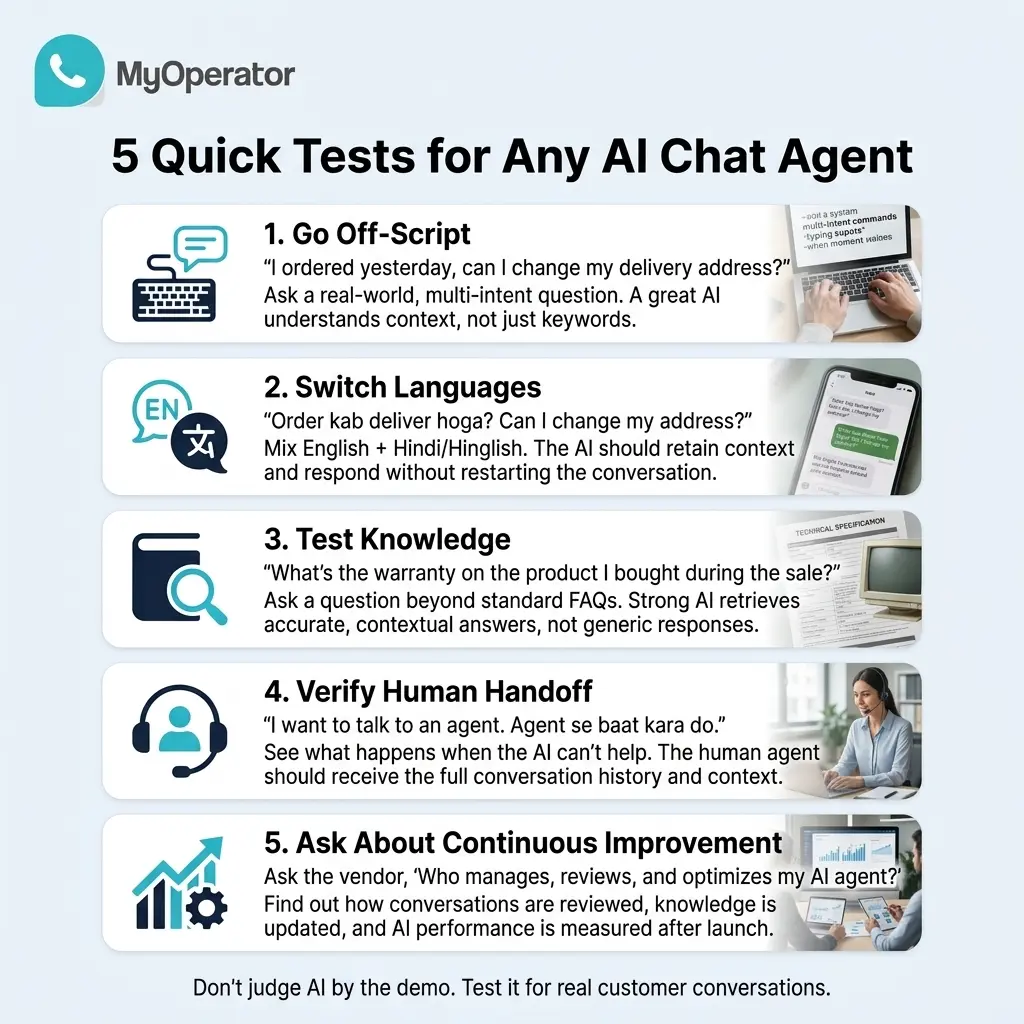
1. Ask an off-script question
Don't start with a simple FAQ. Ask something that combines multiple intents or incomplete information.
For example: "I ordered yesterday, but now I want to change the delivery address.”
A capable AI agent should understand the request, identify the intent, and either resolve it or hand the conversation to a human with context.
If the agent falls back to keyword matching or asks you to choose from a menu, you're looking at rule-based automation rather than conversational AI.
2. Switch languages mid-conversation
Many platforms advertise multilingual support. Fewer can maintain context when customers naturally move between English, Hindi, or Hinglish.
Try asking: "Order kab deliver hoga? Also, can I change my address?"
The important question isn't whether the platform recognises Hindi. It's whether it understands and acknowledges the customer's intent in both languages without resetting the conversation.
3. Test knowledge retrieval
Ask a question that isn't likely to appear in a predefined FAQ.
For example: "Which warranty applies if I bought the product before your latest pricing update?"
A strong AI agent retrieves the answer from its knowledge base or customer database. A script-based AI responds with a generic message or asks you to contact support.
4. Force a human handoff
No AI resolves every conversation. Ask the vendor to demonstrate exactly what happens when the AI cannot help.
We outlined the 7 Escalation Triggers That Should Always Escalate A Call to help you better evaluate this metric.
Check whether the human agent receives the full conversation history, customer details, and previous context, or if you have to repeat everything from scratch.
5. Ask how the AI improves after deployment
Launching an AI chat agent is the starting point, not the finish line.
Ask who reviews failed conversations, updates prompts, expands the knowledge base, and measures containment rates.
The quality of that operational process often has a greater impact on long-term success than the underlying language model itself.
Why MyOperator AI Chat Agents Are The Best Fit for Growing Indian Businesses
Most Indian businesses discover the channel problem after they've already deployed AI agents.
One WhatsApp agent, one calling setup, one CRM — separate, disconnected tools with no shared context. MyOperator's Business AI Operator was built around eliminating that gap.
WhatsApp AI, Voice AI, and Calls on One Customer Record
The WhatsApp AI Chat Agent, AI Voice Agent, and call management system share a single customer record.
A sales rep picking up a warm lead knows what they asked the chat agent yesterday. The chat AI agent handling a WhatsApp query can access the customer’s call transcript from last week. That continuity of context changes the quality of every conversation.
A Dedicated AI Manager, Not a Self-Service Builder
Every Business AI Operator plan includes a dedicated AI Manager from MyOperator's team; an AI expert who builds and manages the agent, monitors its performance, and refines it as your business conversations evolve.
Most platforms sell you a no-code builder and leave configuration to your team. MyOperator runs the operation. To understand why we insist on an AI Manager for every deployment, see Why 95% of AI Pilots Fail and What Actually Works.
DPDP and Meta Compliance Managed, Not Outsourced to Your Team
DPDP Act consent flows, Meta quality rating monitoring, and template approval management are handled within the managed service layer. Your team doesn't need to build the compliance infrastructure from scratch.
For the full picture for Indian businesses using WhatsApp, see WhatsApp Compliance in India: DPDP Act, Meta Policy Updates, and WhatsApp Username Shift (2026).
MyOperator AI Chat Agents: Which One Fits Your Use Case?
All agents above run on the Business AI Operator platform, which unifies WhatsApp AI, voice AI, and call management.
The Right AI Chat Agent Depends on Two Honest Answers
Every conversational AI platform on this list does something well. Your decision should be solidified by answering two questions honestly:
- What does my business actually need an AI chat agent to do? Generate leads, resolve support queries, automate bookings, or handle customer conversations. That tells you what process needs to be automated.
- Who will manage my AI agent after it's deployed? The success of an AI chat agent depends on ongoing optimization, knowledge management, and monitoring. That's tells you whether to go for an AI chat tool or a managed AI platform.
If your business needs a standalone WhatsApp AI chat agent for a specific use case, several platforms on this list are worth evaluating.
If you're looking for a unified platform that combines WhatsApp AI, voice AI, cloud telephony, and managed AI deployment, MyOperator's Business AI Operator is built specifically for Indian SMBs and mid-market businesses to unify customer context across channels.
Find our complete evaluation framework for AI chat agents here: Complete Guide on AI Chat Agents in India
Related Reads:
A Complete Guide on AI Chat Agents in India in 2026
What 300,000+ WhatsApp Messages Reveal About AI Adoption in 2026
WhatsApp AI Chatbots for Lead Generation: What They Actually Do
Best Multilingual AI Chat Agents for Indian Languages in 2026

.avif)


.webp)


