









Every AI voice vendor pitch leads with the same promise:
- Automate as many calls as possible
- Minimize human involvement
- Cut call handling costs to zero.
It's the wrong framing. One that leads to most AI voice deployments in India quietly damaging customer relationships instead of improving them.
The businesses getting the best results from AI voice agents aren't the ones automating the most calls. They're the ones automating the routine interactions and handing off the complex ones.
Full call automation without an intelligent escalation path produces a worse experience than the legacy IVR it replaced. This blog piece looks at why your AI calling agent needs escalation logic, scenarios that should trigger an AI-to-human call transfer, and how to design the human escalation fallback.
Why "Automate Every Call" Is The Wrong Goal For AI Voice Agents
If your evaluation criterion for an AI voice agent is simply "what percentage of calls does it fully automate," you're optimizing for the wrong number.
An AI voice agent that automates 95% of calls but mishandles the remaining 5% will cost you more in damaged relationships than one that automates only 70% but escalates the other 30% cleanly and at the right moment.
This isn't an argument against AI automation.
It's an argument for treating escalation as a designed feature of the system, not an embarrassing edge case you hope customers never face.
Fallback Design In AI Voice Agents: How Human Handoff Happens
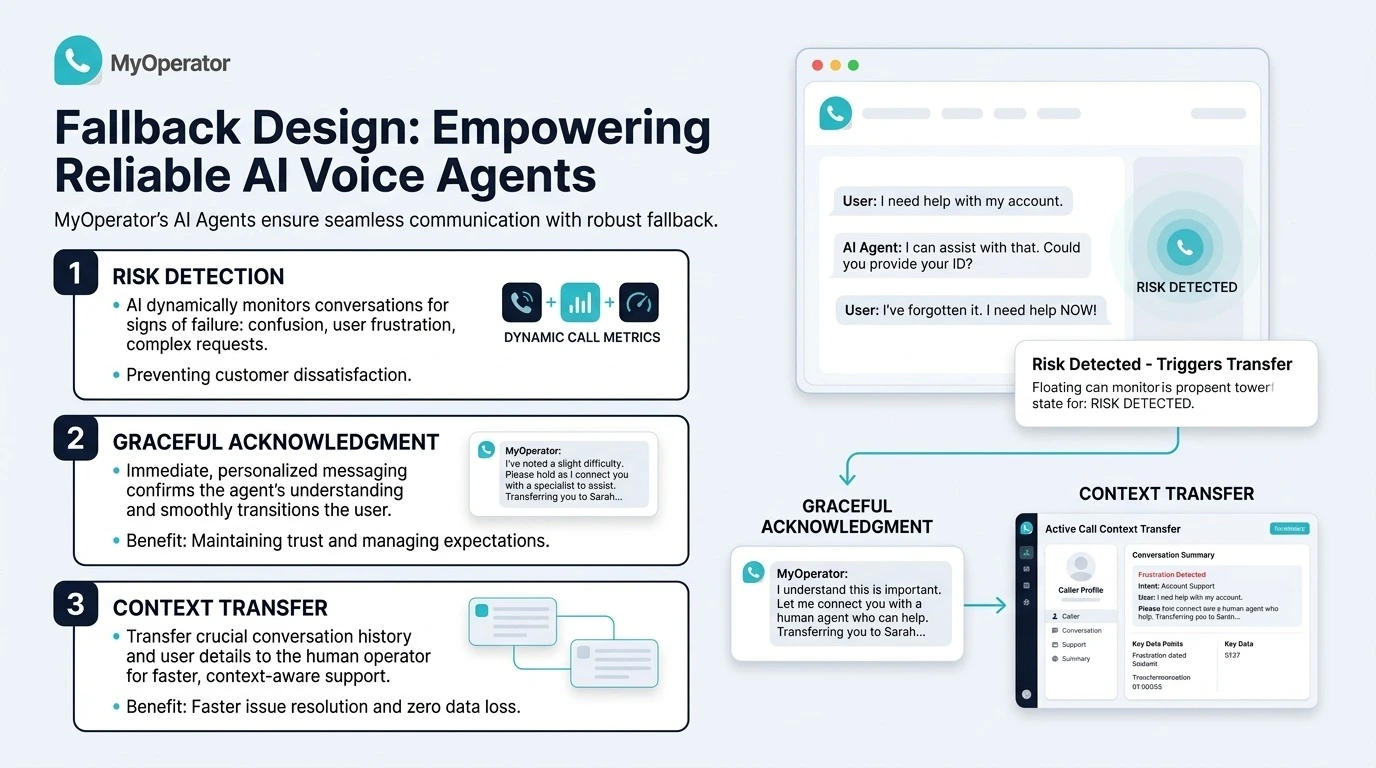
Fallback design in AI voice agents refers to what happens in the moments right before and during an escalation. A good AI-to-human fallback design has three components:
1. Risk Detection
The system needs to recognize a trigger condition (from the list above) in real time, not after the call has already gone sideways for 30 seconds. Customers don’t wait too long to abandon the call. A useful rule is this: the system should detect risk before it triggers, not just after.
Low intent confidence, negative sentiment, repeated interruptions, sudden topic shifts, and explicit human requests are signals that continuing the automated flow is more likely to damage the interaction than resolve it.
2. Graceful Acknowledgment
The caller should never feel like the system silently gave up.
A brief, honest acknowledgment message, like "Let me connect you with someone who can help with that," does more for trust than a seamless-sounding transfer that leaves the caller unsure what just happened.
MyOperator’s AI Voice Agents have a custom handover message to fill the silence when the call is being transferred, making the latency feel a lot more natural.
3. Context Transfer
This is the step most legacy IVR systems fail at completely, and it's the single biggest driver of customer frustration during any handoff. If a caller has already explained their issue to the AI agent, they should never have to repeat it to the human who picks up.
The conversation history, intent, and any data already collected need to travel with the call. From the customer’s perspective, the handoff should feel like a continuation of the same conversation, not the start of a second one.
7 Escalation Triggers That Should Always Escalate A Call
1. Repeated failure to understand the caller.
If the AI mishears or misunderstands the same query twice, a third automated attempt rarely fixes it and usually frustrates the caller further. Escalate on the second miss, not the fifth.
2. Mid-call language switch that the agent can't follow.
Indian callers frequently move between English, Hindi, Hinglish, and regional languages within the same call. If the AI agent's language coverage can't follow the switch, immediately escalate the call to a live agent for a human touch.
3. Explicit request for a human.
"Can I speak to someone?" should never be met with another automated menu. Honor the customer’s request on the first ask.
4. Detectable frustration or distress.
Rising volume, repeated interruptions, or clearly negative sentiment are signals that the automated flow is making things worse, not better, for this specific caller.
5. Compliance-sensitive or regulated topics.
Complaints involving financial disputes, medical details, or anything with legal exposure should be routed to a trained human, both for customer experience and for your own liability.
6. High-value conversations or complex negotiations.
A large enterprise plan deal or a complex multi-party booking benefits from human judgment in a way a scripted flow can't replicate, regardless of how sophisticated the AI model is.
7. Genuinely out-of-scope requests.
If a caller asks something the AI agent was never trained to handle, the right move is a fast human handoff, not an improvised answer that might be wrong.
AI-Only vs. AI + Human: Why Human Handover Matters For Calls
A call that should have been transferred but wasn’t is not just an automation failure; it is a customer experience failure.
Here’s how you can automate call handling with AI voice agents while ensuring every escalation trigger is seamlessly routed to a live human agent.
What A Good AI-to-Human Call Handoff Looks Like In Practice
Put the three components together, and a good handoff has a specific shape: the AI recognizes early that a call needs a human (not after multiple failed attempts), it tells the caller plainly what's happening, and the human agent who picks up already has the caller's issue, sentiment, and other details on the screen before they say hello.
This is the model MyOperator's AI Voice Agent is built around:
AI handles repetitive interactions at scale. Humans step in where judgment, compliance, negotiation, or empathy affects the outcome.
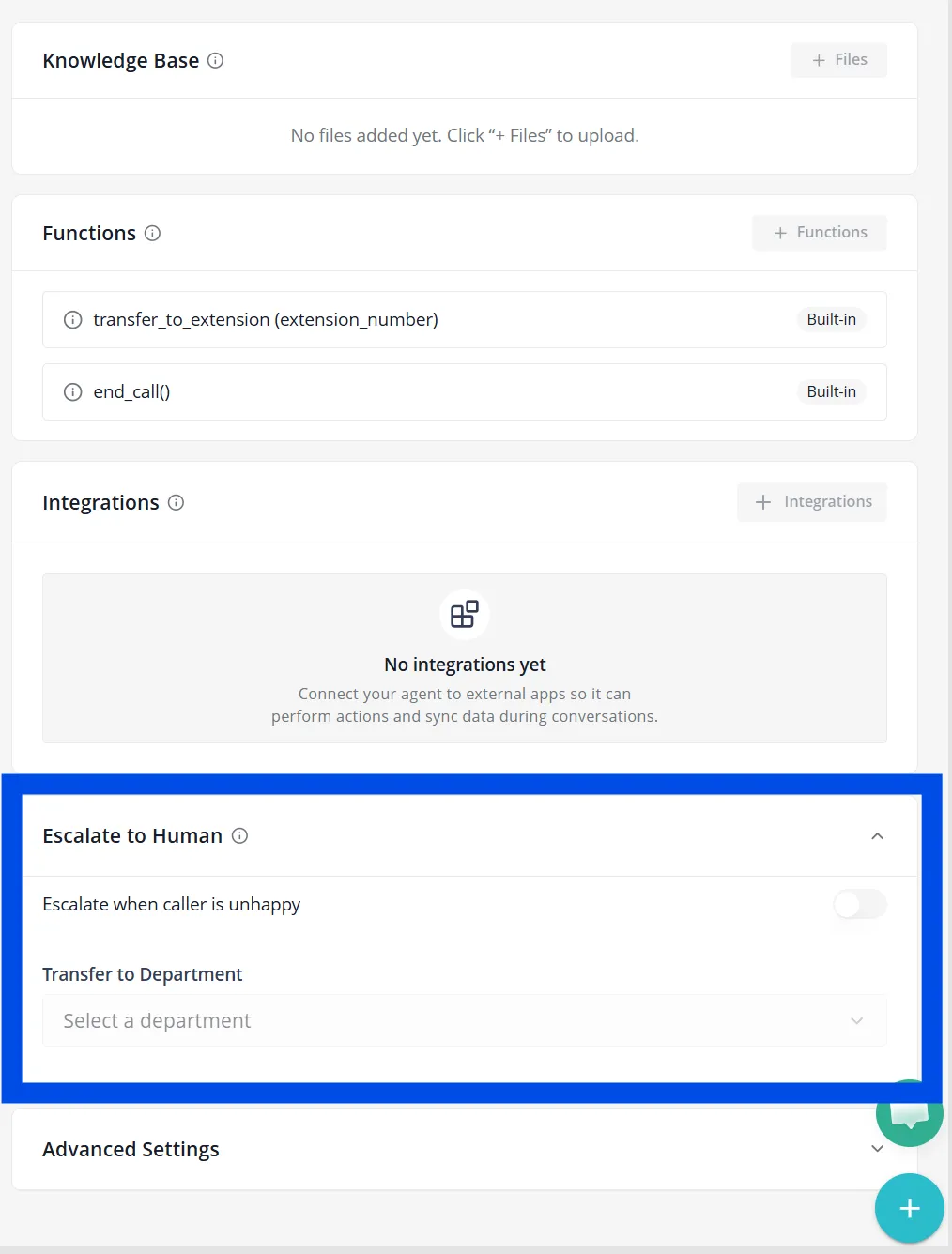
Because the handoff logic for MyOperator’s AI voice and chat AI agents is configured through a no-code workflow builder, even non-technical users can define escalation rules. The LLM-based workflows accept natural text inputs to learn triggers such as repeated understanding failures, language switches, or a request for a human without any coding.
How To Set Up AI-to-Human Handover Without Over-Engineering It
You do not need a perfect escalation matrix on day one.
Start with the three triggers that create the highest business risk: explicit human requests, compliance-sensitive topics, and repeated misunderstandings. Launch with those, review escalated calls weekly, and add additional triggers based on real call patterns rather than theoretical edge cases.
For MyOperator’s AI voice agents, these escalation conditions can be configured through no-code, LLM-based prompts, allowing teams to define handoff logic in plain language rather than building complex rule trees or custom integrations.
For call centers evaluating automation, the question isn’t whether AI can answer every call. It’s where human judgment changes the outcome.
Our detailed comparison of AI voice agents vs. traditional call centers breaks down which interactions can be fully automated, which require human agents, and where an AI-human hybrid model delivers the best operational and customer-experience results.
.avif)



.webp)


