






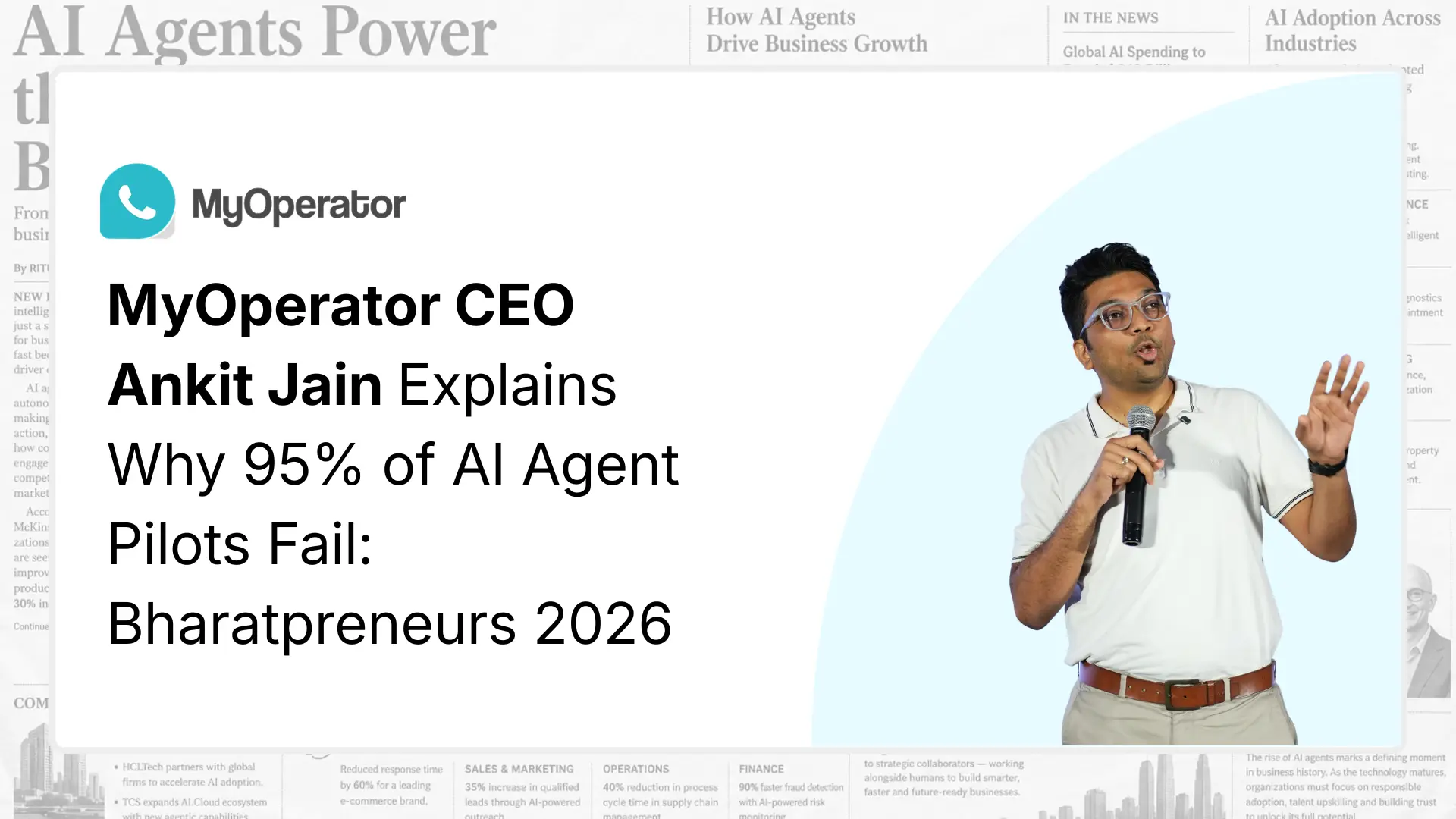


“AI is what we're reading about every day and night.”
Ankit Jain, CEO of MyOperator, opened his session at Bharatpreneurs 2026, the 4th edition of India's premier National MSME and Startup Summit, with every founder, business owner, and attendee in the room nodding in agreement.
Then he said what most AI business founders don’t dare say out loud: 95% of AI agent pilots never reach maturity for deployment.
Jain's experience drew from 200 live AI agents deployed by Indian businesses on the Business AI Operator platform. But research backs him up: a report by MIT's NANDA initiative highlighted a 95% failure rate across generative AI pilots.
"At MyOperator, we help businesses build AI agents. As a company, we’ve been a customer interaction platform for the last 12 years, for 12,000 businesses.
This gives us a deeper insight into how customer interactions across industries work, how you should build your customer interaction journeys, and most importantly, how AI can help you build customer agents.”
His session focused on:
- Mistakes businesses make when building and deploying conversational AI for customers
- What he learned from deploying 200 MyOperator AI agents for Indian SMBs
- Three learnings that help MyOperator deploy AI pilots that move into production
Jain asked the audience a question early on.
"How long does it take in your business to train an intern and get them into a full-time role or to full capacity?"
The answers ranged from a few weeks to 3 months.
Then he asked them how long it takes to take an AI agent live. The answer among attendees was similar: a few hours to a few days.
That gap, Ankit Jain believes, is where the problem with most AI deployments starts.
Here's how Ankit Jain broke down the three mistakes that derail most AI pilots in India, and how those lessons shaped MyOperator's Business AI Operator platform.
Mistake #1. Treating an AI Agent Like Software Instead of a New Hire

"AI is a pretty smart intern," Jain told the room. "Imagine the smartest intern you've ever hired. But you still need to spend days giving them your context, your customer history, your edge cases. You need to have time and patience to do that."
A new hire shadows the manager, gets corrected mid-call, and slowly earns bigger responsibilities over weeks.
Most companies give AI agent deployments less onboarding than interns, and expect them to start performing from day one. When the deployment fails, like most AI pilots, the verdict is usually the same: the AI wasn't good enough.
"We deploy an agent and think the job is done," Jain said. "But what about the on-the-job training? Every [AI] agent needs that."
The right training makes an AI system competent. Keeping it competent over time is an entirely different problem.
Mistake #2: Deploying an AI Agent Without Anyone Owning It
Jain believes, just like a team of humans, even AI deployments need a manager.
Otherwise, no one watches what it says, no one steps in when it's wrong, and no one improves it after launch.
"One common thing we all surely must have observed when building an AI agent is, when we start, we’re like ‘wow, this is amazing.’ But when we start deploying, there are other challenges."
As businesses evolve, so do their conversations with customers. Without continuous monitoring, optimization, and refining, the performance declines.
Jain mentioned how every client using MyOperator's AI deployments gets a dedicated AI Manager: a human expert who knows how to build, train, and optimize AI agents for real business conversations.
Treating customer-facing AI like an ongoing product consistently outperforms leaving it on autopilot.
Jain believes that's not the only human you need in the system.
An AI manager keeps the agent sharp over time. But you also need someone ready to step in when the AI hits a wall.
Mistake #3: Expecting AI Agents To Handle Every Conversation
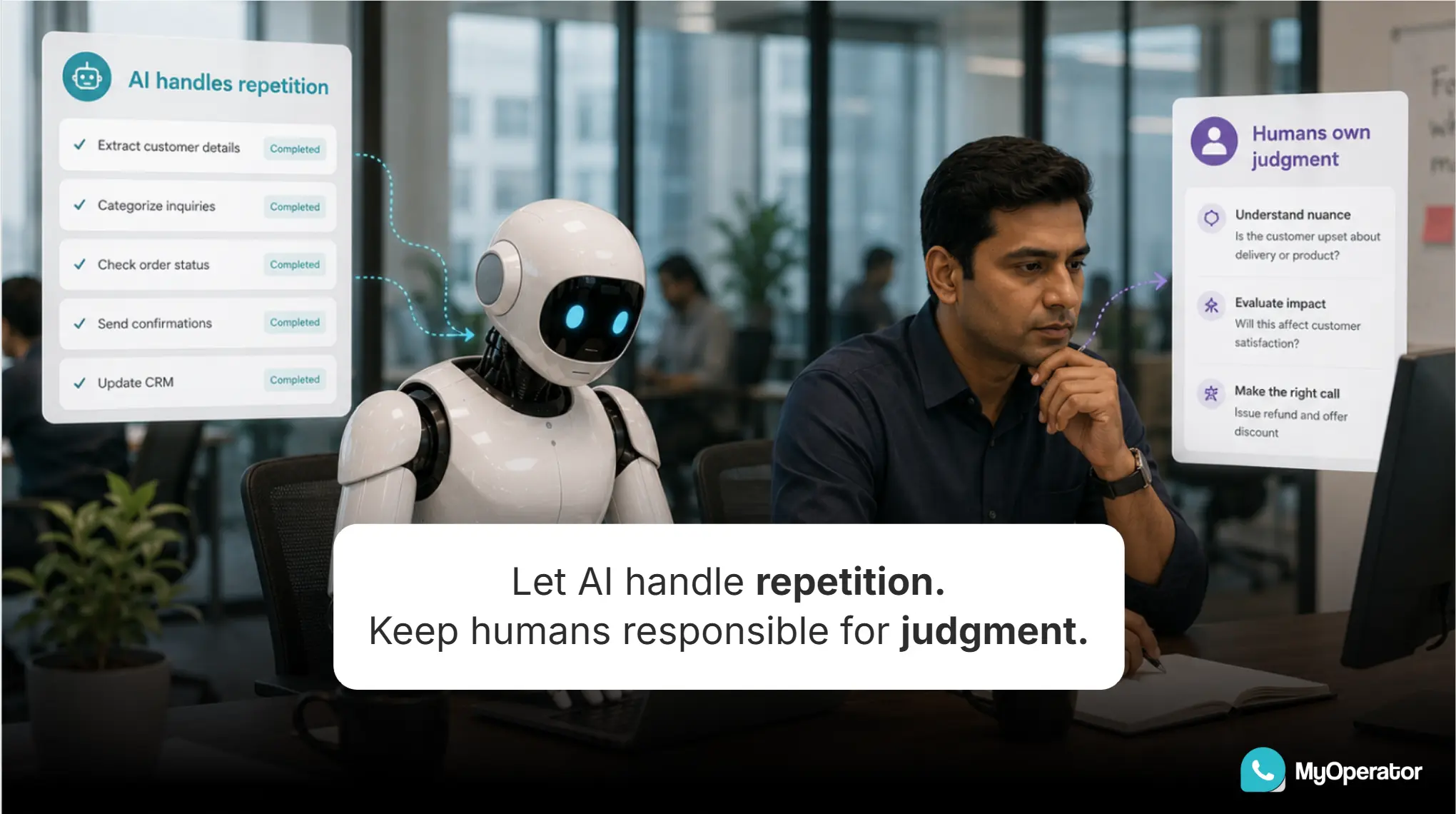
An AI assistant that owns one process, say, booking an appointment or qualifying incoming leads, can be measured and its role can be expanded over time. That does not mean it should operate in a silo.
"Let AI handle repetition. Keep humans responsible for judgment."
Jain recalled a conversation with a client expecting his voice AI agent deployment to handle all calls. In reality, it managed ~80% of inbound calls, while the rest required a human handover mechanism.
He clarifies, "Let AI handle repetition. Keep humans responsible for judgment and emotions."
That's the part most businesses experimenting with AI pilots miss: they either automate too little or hand over too much.
Most Businesses Already Have Enough To Deploy A Conversational AI
"Your best AI process is hidden inside your best 100 customer conversations," Jain said. Not in policy documents or training decks. In the actual calls and chats your best people have already had with customers.
Agents trained on generic FAQs and scripts miss most of the customer context.
The nuance of how your best sales reps qualify a lead, how your support team responds to an upset customer, or the questions a customer from a Tier 2 city asks in Hinglish is just sitting in your call and chat logs.
"Data is the oil of AI," Jain told the audience. "At the end of all of this, you're going to need this oil, even if you don't want to share it with OpenAI," he joked.
The Business AI Operator Model: Why Infrastructure Alone Isn't Enough
Jain closed the session with a formula:
CPaaS + AI Agent + Human to Monitor + Human to Handover
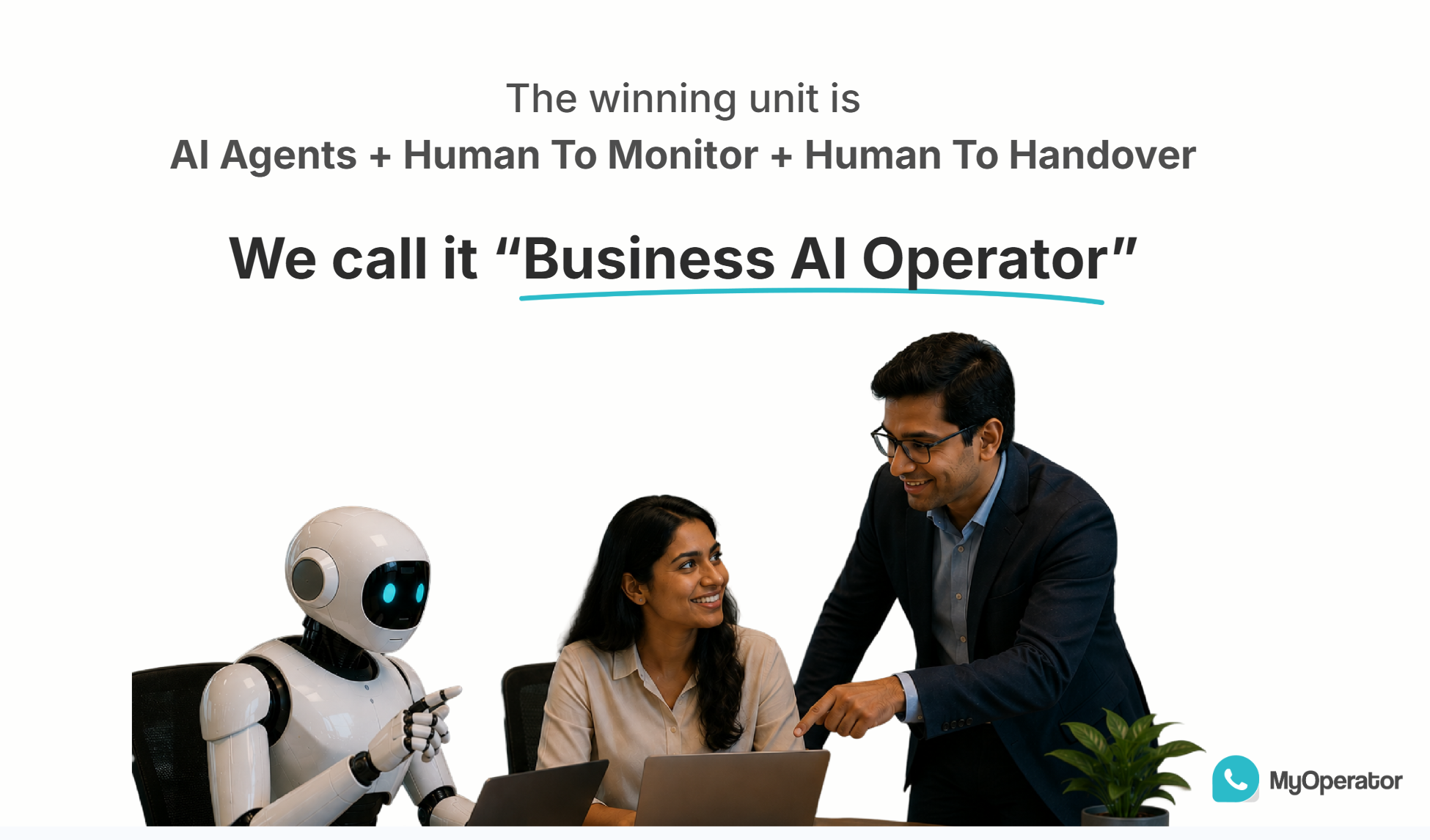
He called it the Business AI Operator model.
The AI handles routine volume. One human manages and improves its performance. Another steps in when the conversation needs judgment, empathy, and negotiation.
Most companies skip all three, then wonder why the pilot failed.
MIT's project NANDA highlighted a finding worth paying attention to: companies that bought AI solutions from a vendor and built a real partnership around it succeeded about twice as often as companies trying to build entirely in-house.
Three Questions to Ask Before You Deploy
Jain ended the session with a line that stuck.
"It replaces the boring parts. And that's the best thing about AI.
The point being: the goal isn't to replace your team. It's to give people back the parts of their day that are spent on repetitive tasks and processes in the first place.
After the session, Ankit Jain drew up a simple framework for founders, solopreneurs, and AI adopters yet to make their first real AI investment.
"Three questions to ask before you deploy anything:
● Who is going to manage and refine it?
● When does it hand over to a human, and how fast?
● Is it working from conversations with actual customers, or a script?
Get these three things right, and your AI pilot has a shot at becoming an enterprise AI system that runs your processes day to day.”
MyOperator's Business AI Operator platform is built around exactly these three answers.
Every AI implementation ships with a trained AI voice agent or chat AI agent, a dedicated AI Manager, and a human handover path, built from day one.

Businesses don't need better AI models. They need better AI operations.
That, more than the AI model’s capability or pricing, determines whether an AI pilot becomes part of everyday business.
Learn More About MyOperator’s AI Deployments:
.avif)



.webp)


