








Most comparisons between a Sales Development Representative (SDR) and a Sales AI Agent line up a salary against a software subscription. That comparison is economically incomplete: a subscription price and a base salary aren't the same, and comparing them tells you nothing about which option actually produces more qualified pipeline for what you spend.
If your team needs another SDR, is deploying a Sales AI Agent instead the better economic decision?
This piece answers that question by comparing the fully loaded cost of each option, not the headline number, plus a common unit to compare them on the most critical metric: cost per qualified lead. We also share a cost framework to run against your own numbers to help you make the best decision for your business.
SDR vs AI sales agent: the three ways to run your top of funnel
Before comparing the cost of "SDR vs AI agent", it helps to define your top-of-funnel work because the two behave very differently, changing the total cost, sales outcomes, and qualified volume.
SDR-only
A human sales development rep handles every stage: first contact, qualification, objection handling, and handoff to a closer. This is the default most businesses run today, and it's the baseline this piece compares against.
AI-assisted SDR
An AI Sales Agent handles first-touch and repetitive qualification, then hands a warm lead to the existing SDR team for conversations that need judgement and negotiation. The headcount stays the same, but the SDR's work shifts from chasing volume to converting it.
AI-led first touch
The AI Sales Agent owns speed-to-lead response and initial qualification for the full inbound volume, escalating only what clears a defined bar to a human sales agent. This is the model most relevant to this piece and answers the question: if you need to add capacity, does it come from a new hire or from an AI deployment?
The rest of this piece compares “SDR-only” against “AI-led first touch” as that's the direct substitute for the hiring decision. Where AI-assisted SDR changes the economics, we mention it explicitly.
Sales Development Rep (SDR) Cost in India (2026): The fully loaded number
We start with the base salary and immediately hit the first problem: public salary data for SDRs in India varies enough to materially alter a break-even calculation.
The spread is worth mentioning, rather than averaging it out. The lower figures capture entry-level or smaller-market hires, the median values come from companies that report on-target earnings, and the higher end reflects SDRs with relevant industry experience. We treat this as a reasonable explanation rather than a documented fact.
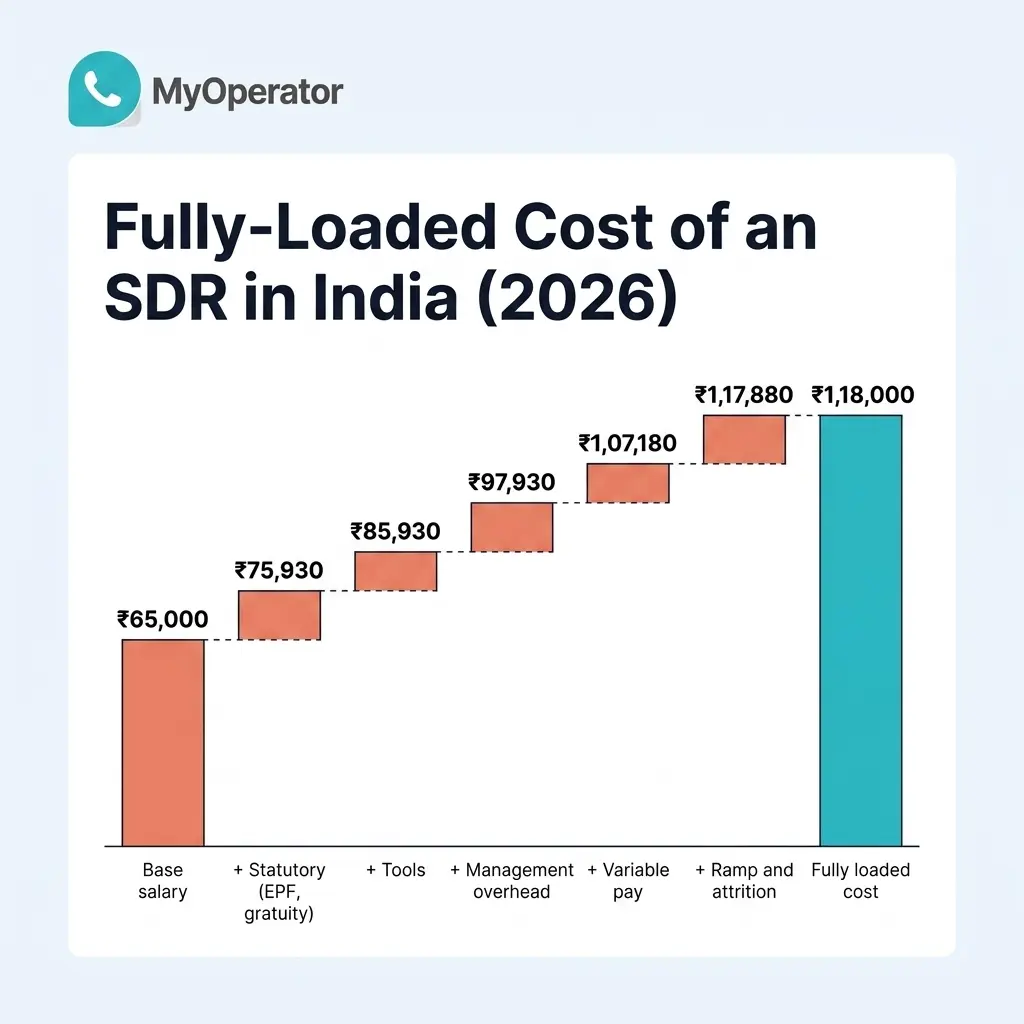
For this piece, an SDR is someone who can run a real qualifying conversation on call for an Indian SMB or mid-market company. Modelling that role, this piece uses ₹50,000–80,000 per month as a working base-salary assumption, with ₹65,000 as the midpoint for the framework below. If your hiring market or role differs, replace this assumption with your own before running the framework.
What sits on top of base salary
Four additional costs are included, alongside the base salary.
Statutory contributions are not an assumption. EPF requires a 12% employer contribution on basic wages under the EPF Act, 1952, and gratuity accrues at approximately 4.81% of basic under the Payment of Gratuity Act, 1972. Across a ₹50,000–80,000 base, that's roughly ₹8,400–13,450 a month combined.
Sales tools are inevitable for every SDR hire. Here, we assume a lean stack with a CRM seat, a prospecting and engagement tool, calling minutes, and a research tool such as a sales intelligence platform. This piece assumes ₹8,000–12,000 a month per rep for that stack. Your actual contracts, seats, and discounts should define this component in the framework below.
Management overhead is real but team-specific, so it's modelled as a formula rather than a fixed figure: a manager's fully loaded monthly cost, multiplied by the share of their time spent coaching, reviewing pipeline, and shadowing the SDR’s calls. A manager paid ₹1,50,000 a month who allocates roughly 8% of their time to one SDR adds about ₹12,000 a month to that SDR's true cost.
Variable compensation depends on quota attainment. RepVue's India data puts average SDR quota attainment at about 61.7%, meaning realized variable pay tends to land well under the on-target figure. Assuming an on-target variable pay of ₹15,000 per month (25% of base pay), expected variable pay at that attainment rate is closer to ₹9,250 per month, not the full ₹15,000.
This brings the total cost of hiring an SDR in India to ₹1,07,200 per month based on a monthly salary of ₹65,000.
Ramp and Attrition Cost: What it adds beyond an SDR's salary
The above still isn’t the fully loaded cost of an SDR until ramp and attrition are added. Both deserve their own line as they aren’t recurring costs.
Ramp is what you pay before an SDR is working at full capacity. The first few months are spent on product knowledge, objection handling, and practice calls before reaching a full call volume. Assuming three months of ramp at 60% below full productivity, on a fully loaded monthly cost of roughly ₹1,07,200, the one-time cost of getting one SDR to full speed runs to about ₹1,07,200 × 3 × 0.60, or roughly ₹1,93,000.
Attrition is what turns a one-time hiring cost into a recurring one. We’re using a common planning assumption in sales-ops benchmarking of 18 months, for which the ramp cost above amortizes to roughly ₹10,700 a month (₹1,93,000 ÷ 18), for as long as the role exists.
Add that to the original figure of ₹1,07,200, and the fully loaded monthly cost of one SDR, amortized for ramp and attrition, is around ₹1,18,000. That's the number the rest of this piece compares an AI Sales Agent against. You may recalculate the figure using your own salary base, statutory contributions, sales stack cost per SDR, management overhead, variable compensation, ramp and attrition costs.
Sales AI Agent cost in India (2026): What it covers (and what it doesn’t)
An AI Sales Agent places outbound calls, introduces the business in the caller's language, asks configured qualifying questions, handles objections it’s trained on, books a meeting, triggers a WhatsApp follow-up, or logs the outcome for the sales team.
MyOperator’s Sales AI Agent can handle conversations in multiple languages, such as English, Hinglish, and 10+ regional Indian languages, with mid-call switching, which matters in India specifically because a real sales conversation often moves between languages. An AI bot built in one language with a translation layer tends to break in such conversations.
No AI deployment owns every part of the job an SDR does. It takes the repetitive, high-volume, time-sensitive work: first response, qualification against a defined script, and follow-up. A human sales rep must be in the loop for complex, multi-stakeholder discussions, emotional conversations, and objection-handling.
The AI side of the comparison has two components. A recurring operating cost covers the platform fee, usage (call minutes or WhatsApp messages), and ongoing configuration and management. A one-time implementation cost covers CRM and telephony integration, script and knowledge-base setup, and initial tuning. This shouldn't be counted as a monthly cost, but it shouldn't be ignored either, so it gets amortized over the deployment period instead.
To model a Sales AI Agent deployment sized to handle one SDR's outbound volume, our working assumption looks like this:
- A platform fee of ₹40,000 a month
- Usage cost of ₹18,000 a month (assuming 3,000 calls a month at ₹6 per call)
- Ongoing configuration and management of ₹15,000 a month
That's ₹73,000 a month recurring.
Adding a one-time implementation cost of ₹1,00,000, amortized over 12 months (a conservative window, since most deployments run well beyond a year), is ₹8,300 a month.
The fully loaded AI Sales Agent cost in our model comes to roughly ₹81,000/month. As with every number in this section, these are realistic assumptions for a real-world example.
Cost per qualified lead: the economic unit for comparing a Sales AI Agent vs. an SDR
An SDR and an AI Sales Agent don't produce the same number of qualified leads for the same cost. The unit that makes the comparison fair is cost per qualified lead: the fully loaded monthly cost divided by the qualified leads produced in a month.
We call this “expected revenue per qualified lead” for this calculation: So, if a closed deal is worth ₹50,000 in revenue and one in five qualified leads closes, that's ₹50,000 × 20%, or ₹10,000 in expected revenue per qualified lead. If you want a more conservative calculation, substitute the numbers with what’s realistic for your business.
SDR vs AI sales agent: the break-even comparison
This section combines the fully loaded costs of each model above against qualified leads each option produces.
A sales development representative spends time on prospecting calls, CRM management, discovery, and follow-ups, often achieving 2 qualified leads daily. Across 22 working days, that’s 44 qualified leads a month. Against the fully loaded cost of ₹1,18,000, that's roughly ₹2,680 per qualified lead.
An AI Sales Agent can achieve 3,000 calls/monthly, and at a conservative estimate of a 3% call-to-qualified-lead rate (your actual rate depends on script quality, list quality, and offer fit), produces 90 qualified leads per month. Against the fully loaded cost of ₹81,000, that's roughly ₹900 per qualified lead.
While these are stated assumptions, the AI Sales Agent produces a qualified lead at lower cost than hiring a new SDR, largely because it can sustain a call volume no single SDR can match.
If your SDR covers your lead volume within minutes of it arriving, or if your calling volume is too low to reach the AI's cost floor, the SDR hire may still be the better economic call. Run your actual numbers, such as the base salary, sales tools stack, call volume, and qualification rate, below to understand what makes sense for your business.
Note: This is a decision-support framework, not financial advice. Treat its output as one input among several.
Where an AI sales agent wins: speed, concurrency, and volume
One advantage of an AI Sales Agent that no human can match: concurrency. A human SDR can only work one conversation at a time, while an AI Sales Agent can start a conversation the moment a lead arrives, regardless of how many other leads arrived in the same minute.
That matters because response time has a measurable, well-documented effect on qualification. The MIT / InsideSales.com Lead Response Management Study, which analyzed over 15,000 leads and 100,000 call attempts across six companies, found that contacting a lead within five minutes makes it 100 times more likely you'll reach them, and ~21 times more likely you'll qualify them.
A human SDR team can get close to this with a high enough headcount and a tight routing process, but the constraint of one SDR handling one conversation at a time remains. An AI Sales Agent can answer calls or trigger a call the instant a lead enters the workflow, even after-hours, and in the language of their choice.
A live MyOperator deployment offers a more useful benchmark than modelled capacity. Munshi Financials, a B2B outsourcing platform, wanted to onboard CA firms and financial consultants pan-India. Its manual call workflow meant the team made roughly 250 outbound calls every day.
After deploying MyOperator’s AI Voice Agent for initial outreach and qualification, it increased that capacity to 1,000+ calls a day without adding headcount. The number of qualified leads escalated for closing grew from roughly 10 to 50 a day, all without hiring new SDRs.
The biggest impact was in how the sales team spent its time. Instead of screening prospects themselves, senior consultants could focus on the AI-qualified leads and onboard prospects much faster. It’s worth noting that despite the Sales AI Agent, Munshi Financials still needed its human sales agents to close contracts, address edge cases, and handle objections.
Where a human SDR still wins: judgement and relationship-led deals
No AI Sales Agent, even ours, can own the top-of-funnel. Relationship-led deals, the kind won over months of contact with multiple stakeholders, still need a human who can read the room and build trust across conversations. The AI can qualify and book the first meeting, but it doesn't build the relationship needed to close deals.
Edge cases and novel objections need the same treatment. When a prospect raises something the conversational AI agent hasn't been configured to handle, the right move is an immediate handoff to a salesperson, not an improvised answer that risks the conversation. Even for warm leads, the close usually happens when talking to a human sales rep, while the AI Sales Agent keeps working the follow-up and qualification on everything else in the pipeline. The dividing line isn't AI-led or human-led sales, but asking which parts of the conversation need judgement and which parts are routine volume.
What to automate first in your sales pipeline?
If the break-even comparison favours AI for your pipeline, start with the workflow where the advantage is easiest to measure: speed-to-lead. When an inbound lead form or click-to-WhatsApp response arrives, how quickly it gets a response decides the likelihood of qualification. This is where an AI-powered Sales Agent should handle first-touch and qualification.
Once that workflow is proven, lead reactivation is the natural step: leads your team has already paid to acquire but no longer has the time to work. A Sales AI Agent can work the qualified pipeline’s backlog while responding to every new lead.
In both cases, the strongest business case isn't AI agents replacing your SDRs. It's AI absorbing the volume that's either unworked or not scalable for humans. So the SDRs you already have, or the ones you're about to hire, can spend their time on conversations where judgement, not speed, decides the outcome.
The best way to compare a human agent and an AI agent for sales is on the cost per qualified lead. If AI comes in meaningfully cheaper, that's your business case: deploy before you hire. If your SDRs already reach every lead within minutes and your real bottleneck is judgement, not speed, then hire instead.
.avif)



.webp)


