








Indian SMBs and mid-market businesses often outsource customer support because the model is familiar and proven.
However, with reliable customer support AI agents emerging, business owners are now comparing the cost of Support AI agents with an outsourced call center agent.
Most guides compare the two on a per-agent cost basis. However, that leaves out factors like the right size of the outsourced team for your support workload, hidden costs for scaling, how many queries an AI agent actually resolves, and most importantly, the cost of customer resolution.
This piece compares an AI Support Agent against an outsourced call center on cost per resolution, not the cost per agent or cost per connected call. We also share a cost-based framework that you can run on your own volume to understand which model is the best fit for your business.
Cost Per Resolution vs Cost Per Agent: The Number That Actually Matters
"Cost per agent" is the figure any Indian call center or BPO quotes first, because it makes outsourcing look cheap next to an in-house support agent’s salary.
An agent handling 100 calls a day at a 60% first-contact resolution rate resolves 60 queries. An agent on the same rate handling 100 calls at 40% resolution clears only 40. Despite the same cost per agent, their cost per resolution differs. Cost per agent tells you nothing about the customer experience the outsourced team provides.
Cost per resolution is a more useful operating metric for customer support teams as it connects spend to an actual outcome: a ticket closed, a complaint resolved, or a booking confirmed without a callback. It's worth tracking alongside CSAT, SLA performance, and escalation rate.
In this comparison piece, we’ll break down the total ownership cost of an outsourced call center agent vs. a support AI agent on cost-per-resolution.
Outsourced Call Center Cost in India (2026): Per-Agent and Hourly Rates
For an Indian business outsourcing support domestically, the dedicated-agent model is the usual quote. Recent 2026 pricing guides from Opsio, Octopus Tech, and AB7 Solutions put fully-loaded dedicated-agent pricing in a consistent band:
Then there's what the headline rate leaves out.
A 2026 outsourced-pricing analysis notes that setup, telephony, QA scoring, call recording, and reporting commonly add 10–20% on top of the quoted seat rate, and cites voice attrition of 30–45% (QATC).
Attrition is the quiet cost nobody accounts for: every departure means the replacement ramps from zero on your product knowledge, escalation logic, and scripts. This generally means you cannot outsource your support volume to 2-3 agents, but to an entire team of call center agents that can survive attrition without collapsing your entire outsourced operation.
So, what is the minimum team size you pay for, and how does that change your outsourcing cost?
Minimum Call Center Team Size in India: How Much Does Outsourced Customer Support Cost?
Here's the constraint that reshapes the whole decision for a smaller business. The cited Opsio and Octopus Tech guides report minimums in the 10–15 agent range for dedicated teams. The 2026 BPO pricing breakdown puts a dedicated 10–20 agent team at roughly ₹12,60,000–₹37,80,000/month based on the channel mix and resolution efficiency.
That minimum team size matters because it's based on the vendor's operating model, not your support load. If your actual support volume justifies four people, and you are still paying for ten, then the gap between what you buy and what you use rarely shows up.
Whether the outsourcing economics work in your favour depends on your support volume, resolution rate, and the vendor's minimum team size. Most pricing guides don't mention a universal volume threshold, so you must run your own numbers rather than assuming one.
We share a framework in this piece that will help you understand whether outsourcing to a 10-agent team makes financial sense for your business, or whether an AI agent can handle your support workload.
AI Agent for Customer Support: What It Covers and How It's Priced
A Support AI Agent resolves incoming queries on WhatsApp or calls using a configured business knowledge base. It can check order statuses, create support tickets, and route complex conversations to a human agent with the conversation history attached.
WhatsApp is the most common channel for this today, though the same agent can work across other connected channels. For the category overview of this AI agent, see A Complete Guide on AI Chat Agents in India in 2026.
The dividing line within the category is between rule-based bots and knowledge-base-driven agents. A rule-based bot follows a decision tree: it can only answer what it's been explicitly scripted for, and it breaks the moment a customer phrases a question differently than expected. A knowledge-base-driven agent draws its answers from configured source material, handles phrasing variation, responds to follow-up questions with multi-turn context, and knows when to escalate a conversation to a live agent.
MyOperator Support AI Agent vs a Traditional AI Agent
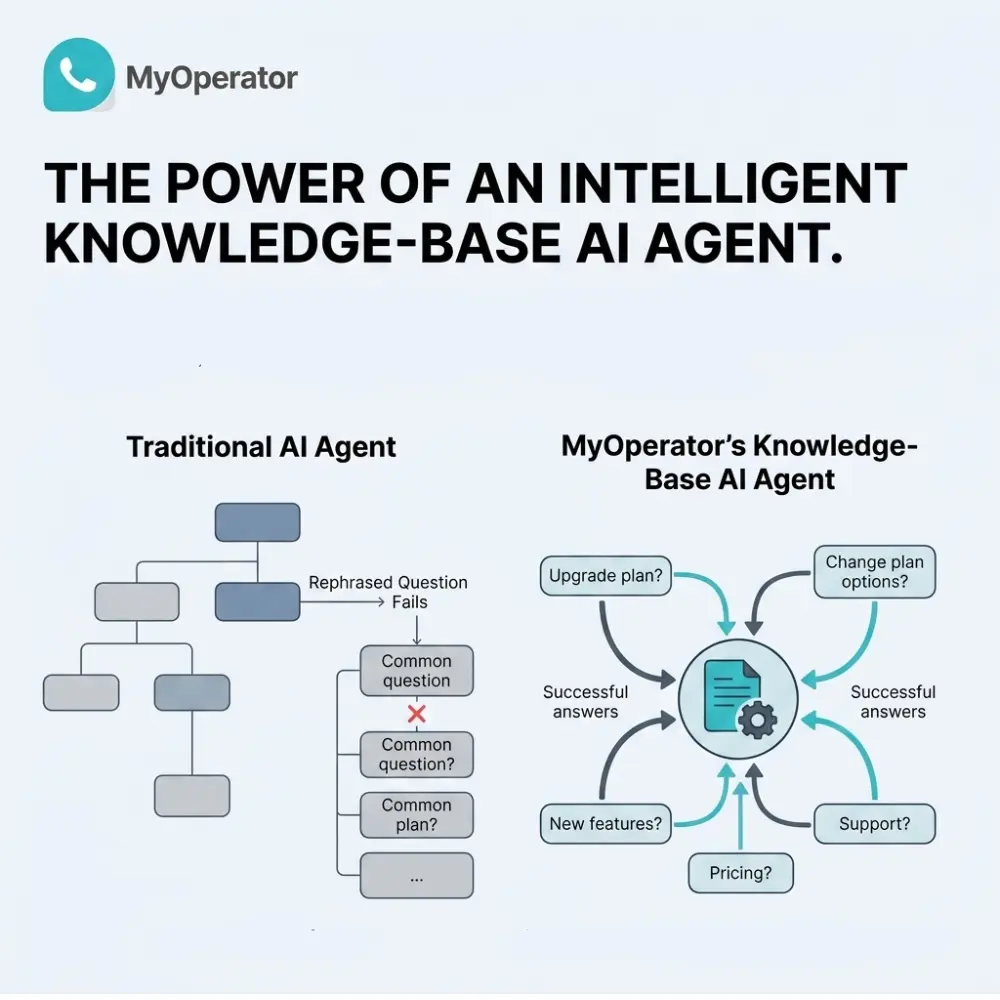
MyOperator's Support AI Agent, part of the Business AI Operator plan, resolves customer queries and shares updates, reminders, and follow-ups automatically on WhatsApp and calls. It is trained on your business data, customer context, and policies to create a knowledge base and can answer in English, Hinglish, and 10+ regional Indian languages.
The plan also includes a dedicated AI Manager who builds, optimizes, and refines the Support AI Agent over time to improve its resolution rate.
Swami Rupeshwaranand Ashram deployed MyOperator’s chat AI agent for customer support.
Post-deployment, the conversational AI agent automated 70–80% of routine inquiries, freeing the team for the cases that genuinely needed a human in the loop. The agent also enabled 24/7, global coverage across time zones, so international inquiries received the same response time as domestic ones.
Unlike a seat-based outsourced call center model, this deployment doesn't require adding a human agent for every increase in repetitive query volume. The AI agent scales as support volume grows.
The question remains: what is the actual cost-per-resolution for an outsourced agent model vs an AI agent for customer support?
AI Support Agent vs Call Center: Cost Per Resolution Compared (2026)
Let’s put the two side by side on the metric that matters. The outsourced side has a fixed monthly cost regardless of how much it resolves. The AI agent is configured to your business needs and support volume, so it isn't capped by headcount.
To better understand this comparison, here’s a worked example you can run against your own numbers.
AI Agent vs Call Center Agent: Cost Per Resolution Using A Real Example
Take a dedicated 10-agent team at ₹15,00,000 a month (₹1,50,000 per agent, within the cited band).
If the team handles around 23,000 queries a month and resolves 65% on first contact, that's about 15,000 resolutions, which works out to ₹100 per resolution. Drop the resolution rate to 45% with the same volume, and the same monthly cost now leads to 10,350 resolutions, roughly ₹145 per resolution.
Now, let’s look at the AI agent with a fixed monthly cost of ₹1,00,000 that covers the AI platform, a dedicated AI Manager, and integrations on a platform like MyOperator. For this comparison, we’ll assume a cost of ₹3 per query handled, built from the WhatsApp Business API's per-message rate.
Running the support AI agent on the same volume (23,000 queries) with the per-query resolution cost (₹3) at two points in the deployment's life: month 1 and month 6.
Two things to note here:
The resolution rate rises without the cost changing. The jump from 60% to 82% isn't simply the AI "understanding customers better," but MyOperator’s dedicated AI Manager expanding the knowledge base and refining escalation logic using the failure cases the first month produced. The total cost of the AI support agent stays at ₹1,00,000/month, but it generates more resolved queries.
The cost per resolution falls when volume doubles because the ₹1,00,000 fixed cost doesn't change with volume. The variable is the cost per resolved query, as doubling the volume at the same resolution rate adds to the total cost (₹69,000 to ₹1,38,000), but the base cost of the managed AI agent remains the same. An outsourced call center can't do this: doubling its support volume means buying another dedicated 10-agent team at ₹15,00,000 a month, which raises the average resolution cost.
To see this model in action:
On the numbers: BPO per-agent rates, minimum team sizes, and attrition figures below are drawn from 2026 industry guides and citations. Resolution rates here are assumptions for modelling. Please adjust them to your support mix.
Outsourced Call Center vs AI Support Agent: When the Call Center Still Wins in 2026
An AI Support Agent is the right tool for repetitive, predictable support queries. Several kinds of queries still need a human agent, and good AI deployments route to them, rather than pretending to cover them.
- High-emotion queries: Complaints, escalations, and any conversation where a customer needs to feel heard needs a person. The AI should route these quickly to your team, while an outsourced team has a person ready to talk to them already.
- Voice support at scale: For voice-heavy operations, human agents and AI voice automation should operate on the same platform. The right mix depends on call complexity and escalation requirements.
- Regulated, script-bound interactions: BFSI, insurance, and healthcare work with strict scripting and documentation may suit a BPO with vertical expertise better than a general-purpose agent.
- Anything needing physical follow-through. A field visit, a document pickup, a hardware swap. The AI can open the query; a human has to finish it.
How to Calculate Customer Support Cost Per Resolution in India
Two inputs decide this: total monthly cost and total monthly resolutions. Here’s how you can calculate both metrics and better evaluate the right choice for your support workload.
Step 1: Split your query mix
Sort a month of support tickets into repetitive (order status, FAQs, booking, payment queries) and judgment-heavy (complaints, disputes, edge cases). The repetitive share is what an AI agent can realistically absorb. The above-cited MyOperator case study reports 70–80% support query automation. Treat this as a reference point for your mix: if your repetitive queries range from 60-80%, then an AI agent becomes a stronger option for your business.
Step 2: Cost each path to a resolution
For the outsourced option, divide the fully-loaded monthly cost, including the total seats (that may exceed your actual need due to the minimum team size), by the queries actually resolved. For the AI option, take the deployment and maintenance cost against the repetitive volume it clears. However, keep in mind that you will need a lean human team for the complex queries that the AI agent escalates.
Step 3: Compare both, and mind the minimum
If your repetitive volume is high enough (60-80%) and your total load doesn't justify 10-20 agents, an AI-plus-lean-human split improves your cost per resolution. If your support queries are varied and dynamic, a team of live agents around the clock through an outsourced model may be justified.
This is a decision-support framework, not financial advice. Treat its output as one input among several.
AI Support Agent vs Call Center vs Both: Which Should You Choose?
For many businesses, the more useful question isn't AI or people.
It's which parts of support should be automated and which should stay with humans. The ones getting this right in 2026 identify the repetitive share of their query volume and automate the categories that are predictable enough to handle safely, while keeping a lean human team (in-house or outsourced) for the queries that need judgment. The AI clears the volume at a cost per resolution that falls as it scales, while the humans handle the cases where being heard by a person is the whole point.
This leaves us with the real lesson of the call-center quote sitting in plain sight. When a vendor's first condition is a ten-agent minimum, they're selling capacity sized for their utilization, not your support volume. A minimum-seat model means you're buying a defined block of capacity, whether or not your current resolution volume fully uses it. Once you start thinking in terms of “cost per resolved customer problem” instead of “cost per agent seat”, most of the reasons to pay an entire outsourced team disappear.
The numbers in this piece make that trade-off concrete. A call center's cost per resolution is ₹100–₹145, or higher if the volume grows, because scale means buying another block of agents. A well-configured AI deployment's cost per resolution for routine queries can move from roughly ₹12 to ₹5.5 as the knowledge base matures and support volume rises.
That difference and your query mix should define your support team’s build. Think of the cost per resolution and flexibility each model delivers for your support team before making a decision.
At MyOperator, we believe the winning formula for support teams is “AI + Human.” Automate what's repetitive, keep people for what needs judgment. If you're exploring an outsourced call center model, we can show you how much of that volume a Support AI Agent could take on instead, so you can maintain a lean human team.
.avif)



.webp)


