






.webp)


Most Indian businesses looking for WhatsApp Business API pricing find one of two things:
- Meta’s global rate card for WhatsApp API cost in Indian Rupees (INR)
- Vendor pricing that shows the platform fee without Meta charges
This makes calculations about WhatsApp API pricing confusing for most businesses in India.
So, if you’re struggling to evaluate how much you will actually pay for WhatsApp Business API, you’re not alone. Finding the actual Meta charges, GST, add-ons, and usage-based costs can quickly overwhelm small businesses and SMBs.
This is a full breakdown of WhatsApp Business API Pricing in India, including Meta's charges, BSP fees, GST, and volume-based pricing in 2026. (Plus, a realistic estimator across three business sizes.)
Why WhatsApp Business API Pricing In India Is So Confusing
The reason WhatsApp API pricing in India feels opaque is that your billing has two distinct layers, but most online guides explain only one.
- Meta's base message charges
- Your WhatsApp Business Service Provider (BSP) platform fees
Secondly, Meta changed its pricing model for WhatsApp Business in July 2025, moving from conversation-based billing to per-message billing. Content written before that date may not describe a billing model that actually applies in 2026. Moreover, effective October 1, 2026, service messages and utility messages sent within the 24-hour window will no longer be free.
The result is that businesses are quoted a number that they later discover is different from their first invoice.
WhatsApp API Cost: Two Layers Every Business Must Know
Here’s what the two cost components for WhatsApp Business API mean:
Layer 1: Meta's per-message charges
Meta charges for every template message you send, based on message category and the recipient's country. These charges apply regardless of which BSP or third-party platform you use. You cannot avoid Meta's base rate, which is often the biggest component of WhatsApp Business API pricing.
Layer 2: BSP platform fees
You cannot access WhatsApp Business API directly without a Business Solution Provider (BSP). Your BSP builds the interface, provides automation tools, manages your WABA (WhatsApp Business Account), and handles onboarding. They charge for this either as a per-message markup on top of Meta's rates, a flat monthly platform fee, or both.
Total WhatsApp API cost = Meta charges + BSP fees + 18% GST
Meta’s WhatsApp Business Pricing in India (2026)
Meta classifies every WhatsApp template message into one of three billable categories. The category determines the rate for each message:
Marketing template messages are 7.5× more expensive than utility messages. So, if you are running broadcast campaigns or promotions, your costs will change significantly at volume.
The 24-hour service window was free since November 2024. When a customer messaged you first, you would have 24 hours to reply with any message (including free-form, non-templatized messages) at zero charge. However, effective 1st October 2026, Meta charges per service message at the same rate as utility and authentication templates. This changes the cost model for support-heavy businesses as messages sent within the service window now have direct cost implications.
On the other hand, Click-to-WhatsApp (CTWA) ad clicks or Facebook CTA button clicks open a 72-hour free window. If a customer lands on your WhatsApp chat from a Facebook or Instagram ad, all messages are free for 72 hours. This is often one of the most underused cost optimizations available for businesses. However, Meta Business Agent replies for CTWA are still charged for token usage as of August 1, 2026.

This is another factor that WhatsApp Business users must be aware of in 2026. As of 2026, Meta revised marketing template rates in India by approximately 10%, from ₹0.7846 to ₹0.8631 per message. However, utility and authentication template rates have stayed the same. Now, let’s look at the BSP component of WhatsApp API pricing for Indian businesses.
What Indian BSPs Charge: Breakdown Of WhatsApp Business API Pricing
Most Indian WhatsApp Business Service Providers’ pricing varies based on the billing model they use:
For most businesses, the right pricing model depends on message volume.
A per-message model usually has the lowest entry cost for smaller teams and SMBs, while a flat-fee model is more economical for higher monthly volumes. Before choosing a provider, estimate your expected usage on both pricing models, instead of comparing monthly subscription prices alone.
Another additional cost that businesses frequently overlook is GST. An 18% GST applies to both Meta's messaging charges (treated as imported OIDAR services) and your BSP's platform fees.
This means your final WhatsApp invoice will be higher than the quoted base pricing. Factor this into your budget when comparing WhatsApp Business API providers.
How Does MyOperator's WhatsApp Business Pricing Compare?
For growing Indian SMBs, the effective cost of a marketing message is a better comparison metric than monthly fees. Plus, utility and authentication template rates vary across providers or are bundled with marketing plans, making comparisons messy.
The table below compares the effective per-message pricing (as of April 2026) for leading WhatsApp Business API providers.
At ₹0.95 per marketing message, MyOperator pricing sits at the lower end while providing official WhatsApp Business API access and much more. For businesses scaling messages every month, even a ₹0.05 difference per message can translate into meaningful savings over time.
Remember this: The per-message rate is only one part of your total WhatsApp Business API cost. Before choosing a provider, compare platform features, automation capabilities, inbox limitations, support quality, and additional subscription fees.
Estimate Your WhatsApp Business Cost: How Message Volume Changes Pricing in India
Most WhatsApp BSPs charge in one of three ways:
- a flat monthly subscription
- a per-message markup
- or a combination of both
To make the scenarios comparable, we assume a flat monthly platform fee that scales with business size. If your BSP uses a markup model instead, your monthly total will vary based on message volume.
The scenarios below use Meta's current pricing (updated April 2026). Your actual costs may differ, depending on provider, plan, and messaging mix, but the examples illustrate how pricing changes with volume.
Small Business (Early Stage) — 5,000 WhatsApp messages/month
Growing Business (Scaling Stage) — 25,000 WhatsApp messages/month
Large Business (Mature Stage) — 100,000 WhatsApp
WhatsApp Pricing Update: October 1, 2026
From October 1, 2026, Meta will charge per message for two message types that were previously free:
- Service messages: Free-form replies your team or chat AI agents send within the 24-hour customer service window (free since November 2024).
- Utility messages sent within an open 24-hour window: Transactional messages such as order confirmations and reminders sent during an active conversation (free since July 2025).
Both are likely to be charged at the same per-message rate as utility and authentication templates, without volume discounts. Businesses with high inbound support volume will see a meaningful increase in monthly WhatsApp costs after October 2026. The more fragmented your replies, the higher your WhatsApp bill.
If this sounds like your business, start consolidating WhatsApp replies into one message to reduce number of responses, improve your CTWA setup as the 72-hour free entry window is unchanged, and re-estimate your monthly WhatsApp cost after October once the changes go live.
What matters most here is that marketing messages drive the majority of your costs, while a minority comes from operational messages (utility, authentication, and service templates).
For instance, at higher volumes such as 100,000+ messages per month, optimizing the ratio of marketing-to-utility messages is worth more than the BSP platform fees.
👉 Read: How Large Enterprises Send Bulk WhatsApp Messages Without Getting Banned
What Determines Your WhatsApp Business API Pricing?
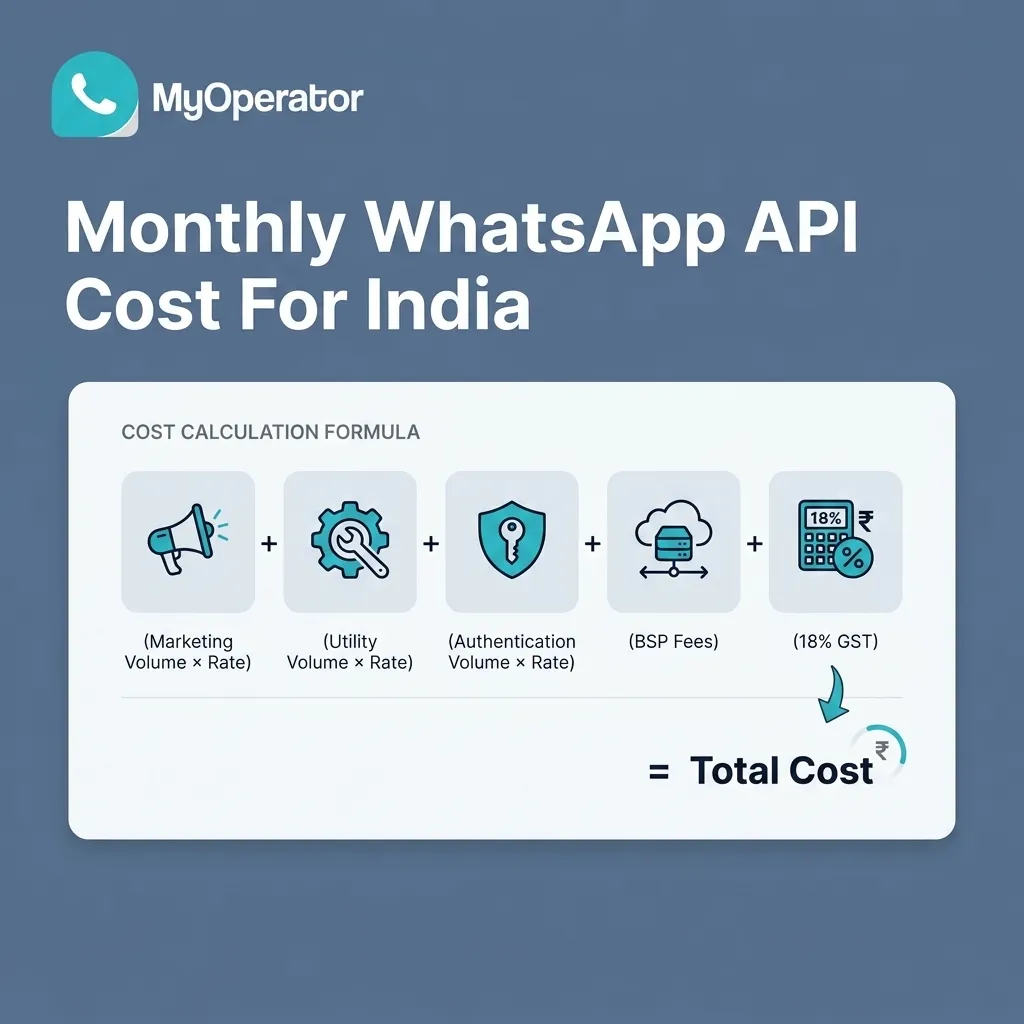
Mix of Message Templates: Marketing messages cost 7.5x utility or authentication messages. If your use case is transactional, such as OTPs, reminders, and order updates, your WhatsApp bill will be a fraction of that of campaign-heavy marketers, even at the same message volume.
Usage of Service Windows: Every reply to a customer-initiated message within 72-hour CTWA service window is free of cost. Businesses with high inbound volumes pay much less per conversation.
Read Now: Learn How To Create A WhatsApp Chatbot For 24/7 Instant Replies
BSP Pricing Model: At volumes above 10,000 messages/month, a flat-fee BSP almost always costs less than a per-message model, although your message mix plays a major role, too. Always estimate your WhatsApp messaging cost on both models before committing.
CTWA As an Entry Point: Leads coming via Click-to-WhatsApp ads or Facebook call-to-action buttons open a 72-hour free messaging window. Moving lead gen campaigns to CTWA instead of landing pages or B2B lead forms significantly lowers your cost per qualified conversation.
Read Now: Why WhatsApp CTWA Converts Better Than B2B Websites In 2026
Additional GST Handling: If your business is GST-registered, you can claim input tax credit on both Meta charges and BSP fees. Unregistered businesses cannot claim this, so remember to factor this into your total cost calculation.
Read Now: How To Get Meta Verified in 2026
WhatsApp Business API pricing in India isn't “expensive” because Meta or BSPs charge too much. It's expensive because most Indian SMBs and small businesses misunderstand how the pricing works.
Businesses that model costs based on their message mix, take advantage of free messaging windows, and compare BSP pricing models before signing rarely face billing surprises later.
Now you know all the factors you should consider before walking into a conversation with any WhatsApp vendor.
Or you can choose MyOperator. With transparent WhatsApp pricing, official WhatsApp Business API, WhatsApp AI chatbots, multi-agent inboxes, and chat automations, we have helped thousands of Indian businesses design cost-efficient WhatsApp messaging workflows.
We give you more than a rate card. You get guidance on reducing unnecessary messaging costs, choosing the right pricing plan, and scaling WhatsApp without billing surprises.
Related reads:
.webp)
.avif)



.webp)


