








Most businesses assume their traditional IVR is doing its job.
Incoming calls are being answered, callers are being routed to different departments, and the phone system appears to be functioning as intended. On the surface, there is little reason to believe anything is wrong.
The problem is that IVR performance is often measured through operational metrics such as call volume, routing accuracy, and average handling time (AHT). Metrics like IVR abandonment rate, IVR ROI, and the cost of lost customers rarely enter the discussion.
That creates a blind spot.
Many businesses invest in an IVR system to improve efficiency, but few evaluate whether their IVR is helping them capture revenue or quietly contributing to revenue leakage. An IVR report shows thousands of calls were answered successfully, while the business remains unaware of how many high-intent callers abandoned the journey before reaching the right person.
This blog explores how traditional IVR systems can create hidden revenue leakage and where AI-powered IVR can help improve IVR ROI while reducing call abandonment. Also estimate your potential IVR revenue leakage with our Free IVR Revenue Leakage Calculator below.
The Hidden Revenue Cost Of Using A Traditional IVR
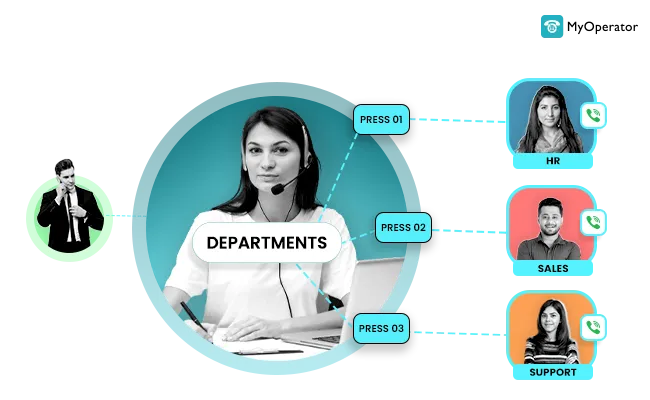
Most businesses purchase an IVR system to improve efficiency. The goal is straightforward: route callers to the right department without requiring manual intervention for every incoming call.
For many businesses, the issue is not whether the IVR system works. The issue is whether the IVR is delivering a positive return on investment (ROI) by helping customers reach a meaningful outcome.
In many cases, traditional IVR succeeds at that task.
The challenge is that efficiency does not always translate into better customer experiences. Traditional IVR systems were designed at a time when routing calls efficiently was the primary objective. The assumption was simple: if callers could navigate a menu and reach the appropriate department, the IVR system was working.
Customer expectations have changed considerably since then.
Today's callers expect businesses to understand their intent and respond quickly. As those expectations have evolved, several limitations in traditional IVR systems have become more apparent. When customers encounter long menus, confusing routing options, extended wait times, or repeated transfers, some simply leave the call. Others reach the wrong team and decide not to continue.
In such cases, businesses lose customers in a way that’s never visible in standard reporting.
What Is IVR Revenue Leakage?
IVR revenue leakage occurs when potential customers abandon calls, are routed incorrectly, or fail to reach the right team, resulting in lost sales opportunities and potential revenue.
Common sources of IVR revenue leakage include:
Call Abandonment
Some callers disconnect before reaching the appropriate team. This is particularly costly when the caller is actively evaluating a purchase or seeking immediate assistance.
Long Menu Navigation
Many traditional IVR systems rely on multiple layers of menus before a customer can reach the right destination. While this may seem logical from an operational perspective, each additional step introduces friction into the customer journey and increases the likelihood of abandonment.
Poor Routing
Traditional IVR systems can route calls, but they generally cannot understand what a customer is trying to achieve. As a result, callers are often transferred between departments before finding the right person.
Missed High-intent Callers
Not every inbound call carries the same value. A prospective customer requesting pricing information is significantly more valuable than a routine enquiry. Traditional IVR systems often struggle to identify and prioritize these opportunities.
Delayed Support Responses
Many businesses continue receiving enquiries long after business hours have ended. Traditional IVR systems can record messages, but they rarely help move the customer toward a resolution. Customers who cannot quickly reach assistance may abandon the interaction altogether or begin evaluating alternatives.
Weak Callback Workflows
When customers abandon a call, there is often no intelligent process for recovering the opportunity. Unless a team manually follows up, the conversation simply ends.
Industry benchmarks suggest that average call abandonment rates often fall between 5% and 8%, with some contact centres reporting rates above 20% during peak periods (Source: Call Centre Helper). While these numbers may appear small, their impact compounds quickly when applied to monthly call volume and customer value.
For small and mid-sized businesses, even a modest abandonment rate can translate into meaningful revenue leakage over time.
A Simple Revenue Leakage Calculation For Interactive Voice Response (IVR) Systems
You do not need advanced analytics or call center software to estimate whether your IVR solution is costing you revenue. The objective is not to arrive at a perfect number, but to understand the scale of the opportunity that may be slipping through the cracks.
A practical way to estimate IVR-related revenue leakage is to look at four variables:
- Monthly inbound call volume
- Call abandonment rate
- Conversion rate of lost callers
- Average customer or lead value

How to Calculate IVR Revenue Leakage
You can estimate potential IVR revenue leakage using the following formula:
Monthly Revenue Leakage = Monthly Call Volume × Abandonment Rate × Conversion Rate × Average Customer Value
- Monthly Call Volume = Total inbound calls received each month
- Abandonment Rate = Percentage of callers who disconnect before reaching the right team
- Conversion Rate = Percentage of abandoned callers who would have become customers
- Average Customer Value = Average revenue generated per customer
The formula provides a directional estimate rather than an exact forecast, but it can help businesses understand how abandoned calls and IVR friction translate into potential revenue loss.
Imagine your business receives 100 inbound calls per day.
Using the formula above:
3,000 × 5% × 10% × ₹10,000 = ₹150,000 per month
That translates to approximately ₹18 lakh per year in potential revenue leakage.
Not every abandoned call would become a customer. However, when businesses begin applying realistic assumptions to missed opportunities, the financial impact often becomes difficult to ignore.
Estimate Your IVR Leakage In Under 30 Seconds
At this point, the most useful exercise is to estimate the impact of IVR revenue loss on your own IVR system.
The calculator is not intended to produce an exact forecast of your IVR revenue loss. Instead, it helps SMB owners quantify a problem that is rarely discussed in operational terms.
When the conversation shifts from abandoned calls to lost revenue, decisions around customer communication become much easier to prioritize.
When IVR Still Helps Businesses And Where It Fails
This is not an argument against IVR entirely.
IVR continues to play an important role in customer communication and remains a useful solution for many businesses.
In situations where callers simply need to reach a department quickly, traditional IVR often performs adequately.
However, the limitations become more visible when customer needs extend beyond basic routing.
The distinction is important. Routing calls and resolving customer needs are not the same thing.
As customer expectations continue to evolve, businesses increasingly need systems that can do more than move callers from one queue to another.
Why IVR Revenue Leakage Is More Expensive For Indian Businesses
Revenue leakage affects businesses everywhere, but its impact is often amplified in India because phone conversations play a larger role in the buying process.
According to ServiceNow's Customer Experience Intelligence Report 2024, Indian consumers spend an average of 30.7 hours on hold with customer service every year. That is more than a full day spent waiting for assistance.
This statistic highlights an important reality for businesses. Customers have become increasingly sensitive to delays, long wait times, and inefficient support experiences. When callers encounter multiple menu layers, extended hold times, or difficulty reaching the right team, their tolerance is often lower than businesses assume.
In many industries, customers are reluctant to make decisions based solely on a website or marketing message. They want to speak to someone before committing. A parent evaluating a coaching institute, a patient booking a consultation, or a prospective homebuyer exploring a property is often looking for reassurance before taking the next step.
This makes every inbound call more valuable.
For many Indian businesses, a phone call is not simply a support interaction. It is a sales opportunity.
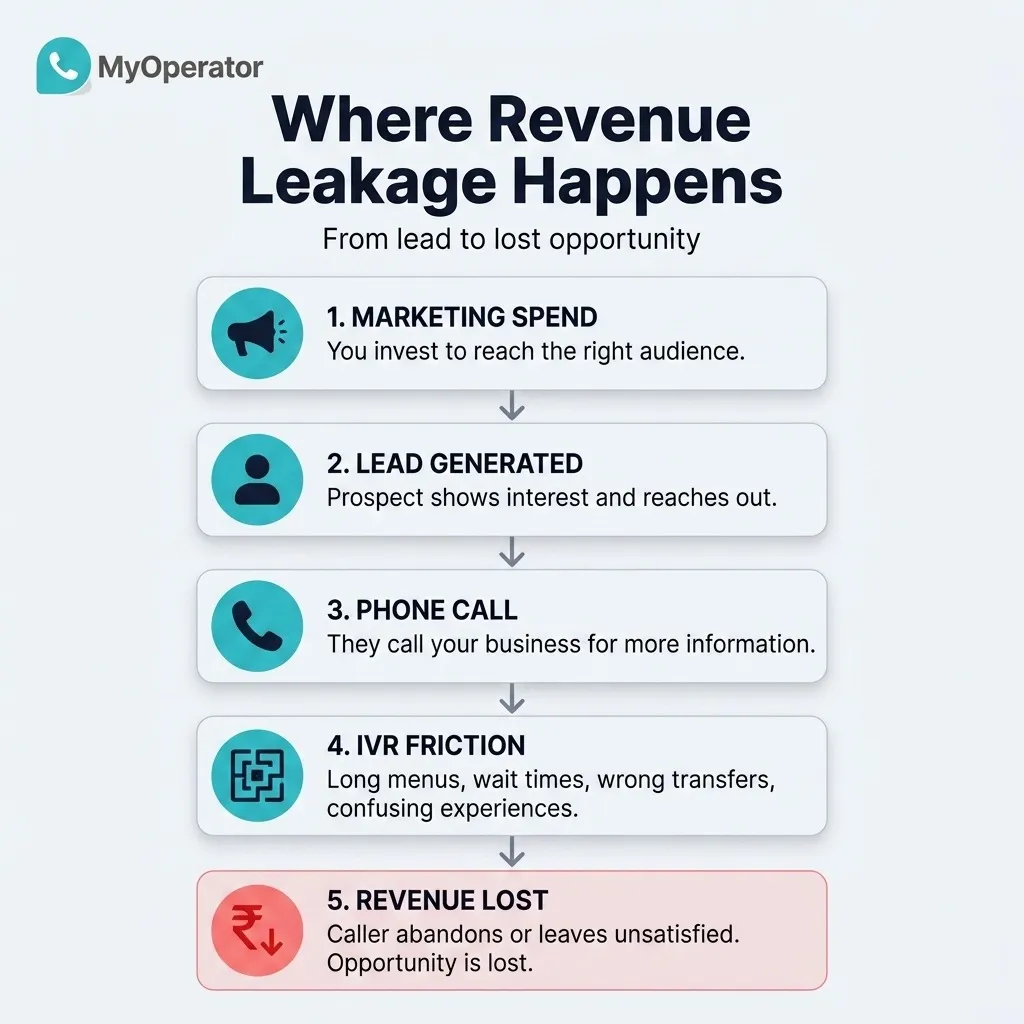
When callers abandon a queue, struggle through multiple menu layers, or fail to reach the right team, the business is not simply losing a call. It may be losing a qualified prospect who was already close to making a decision.
The cost becomes even more significant for businesses that generate leads through digital channels. Marketing teams invest heavily in driving enquiries, only for a portion of those opportunities to encounter friction once they pick up the phone.
This is why IVR performance should not be viewed only through operational metrics such as answered calls or routing efficiency. For many Indian businesses, it is directly tied to revenue capture.
How MyOperator’s AI IVR Reduces Revenue Leakage And Improves Customer Experience
An AI IVR addresses most of the gaps that contribute to revenue leakage in traditional IVR systems.
Many businesses attempt to address these limitations by adding separate tools for telephony, automation, callbacks, analytics, and AI. While this can solve individual problems, it often creates a fragmented customer experience and additional operational complexity.
Built on more than 15 years of cloud telephony expertise, MyOperator's AI Voice Agent for IVR combines conversational AI with the reliability, call-routing intelligence, and communication infrastructure that businesses already depend on.
Instead of requiring businesses to rebuild their communication stack, it adds an intelligent layer that helps reduce abandonment, improve routing accuracy, support multilingual interactions, and recover opportunities that might otherwise be lost.
For example, instead of asking callers to select from a list of numbered options, an AI IVR can simply ask: "How can I help you today?"
The system can then analyze the response, determine the caller's intent, and route the conversation accordingly, improving efficiency and customer experience.
Learn More: IVR vs AI IVR: 3 Reasons Smart Businesses Are Switching in 2026
Businesses typically see benefits in several areas:
Faster response times
AI IVR can answer calls immediately, reducing the likelihood of customers abandoning the interaction before receiving assistance.
Better routing accuracy
By understanding intent rather than relying solely on menu selections, AI systems can direct callers to the most relevant team more consistently.
24/7 availability
Customers receive support even when business teams are unavailable, ensuring that opportunities are not lost outside operating hours.
Multilingual interactions
AI IVR can support conversations in multiple languages, helping businesses serve a broader customer base without significantly increasing staffing requirements.
Improved lead capture
Instead of simply recording a missed call, AI systems can gather information, qualify inquiries, and prepare context for follow-up conversations.
Human escalation when needed
The goal of AI IVR is not to replace human conversations. It is to ensure customers reach the right person at the right moment.
This allows businesses to improve customer experiences while reducing the number of opportunities lost through avoidable friction.
.webp)
Traditional IVR Vs AI IVR: A Comparison For Indian Businesses
Here's a comparison showing where an AI-powered IVR outperforms a traditional IVR:
The objective is not to replace your existing IVR infrastructure overnight, but to upgrade it with an AI-powered layer.
For many Indian businesses, the more practical approach is to identify where customers are abandoning conversations and introduce AI capabilities in those areas first.
The Real Cost Of IVR Revenue Leakage
Traditional IVR systems are often evaluated on operational metrics. However, those metrics do not reveal how many potential customers are lost through abandoned calls, poor routing, or delayed responses.
Businesses that understand and measure IVR revenue leakage are often the first to identify opportunities hidden within their existing call volume. By reducing friction in the customer journey, they can improve both customer experience and revenue outcomes without significantly increasing headcount.

.avif)



.webp)


