








On October 1, 2026, Meta is ending the free service message replies on the WhatsApp Business API, turning open support windows into a per-message operational cost.
If your WhatsApp Business API bill has been predictable in 2026, the math changes on October 1, 2026. Meta is putting a price on the one thing that's been free until now: replies your team or your AI agent sends inside an open conversation. For a business with high inbound volume, that's a new cost tied directly to how many WhatsApp support conversations you handle. This piece answers what changes in October 2026, what it will cost your business, and how you can cut your WhatsApp Business cost per message despite the new charges.
For the full breakdown of WhatsApp API pricing in India, including BSP fees and GST, see our WhatsApp Business API Pricing Guide for India (2026).
What Changes on October 1, 2026
Two message types move from free to charged:
Service messages
Any free-form (non-template) reply your team or an AI agent sends within the 24-hour customer service window that opens the moment a customer messages you. These have been free since November 2024.
Utility messages in an open window
Transactional replies, such as order updates or reminders, sent during an already-active conversation. These have been free since July 2025, distinct from utility template messages sent to start a conversation, which have always been charged at ₹0.115.
Meta's developer documentation confirms both changes take effect on October 1, 2026. Non-template messages delivered during the 24-hour service window will be charged going forward, whether sent by a human agent, chat AI agent, or Meta's Business Agent.
Why These Messages Were Free Until Now
WhatsApp's 2024–2025 pricing model rewarded one specific pattern: get the customer to message first, then reply to them for free. That made customer-initiated support cheaper to run than reaching out first. Many Indian SMBs rebuilt their WhatsApp workflows around this pattern.
October 1 takes away half of that deal. A customer messaging you first is still free. Whatever you say back, if it isn't a template, now costs you money. Here’s what the new WhatsApp template rates look like:
The new WhatsApp template rates (applicable 1 October, 2026)
Both newly charged categories land at the same rate as existing utility and authentication templates. Utility messages have no discount volume tier. However, Meta has introduced a new free tier of 1,000 service messages per business phone number. The count resets every month, and charges will apply only on the 1001st service message and beyond.
Calculate Your WhatsApp Cost Increase
How much this pricing update costs you depends on how many free-form replies your team sends each month inside open conversations, a number most businesses have never tracked.
Use the calculator below to estimate the cost you must absorb from October 2026.
What Stays Free After October 1, 2026
The 72-hour Click-to-WhatsApp (CTWA) free entry window is unchanged. When a customer lands on your WhatsApp chat from a Facebook or Instagram ad click, every message in that 72-hour window remains free, including service and utility replies.
This makes Click-to-WhatsApp a critical acquisition lever. It remains one of the few entry points where you can run a complete multi-turn conversation without triggering per-message Meta charges. One exception: this waiver doesn't extend to Meta Business Agent. Its responses are billed on token consumption regardless of whether the FEP window is open, so if you plan on using it, even for CTWA conversations, the window isn't actually free for you.
Messages users send to your business remain free as they always have been. The change applies only to what you reply. Yet, there are ways to reduce the cost implications on your service and utility messages, especially if you’re operating at scale.
How To Cut Your WhatsApp Cost Increase
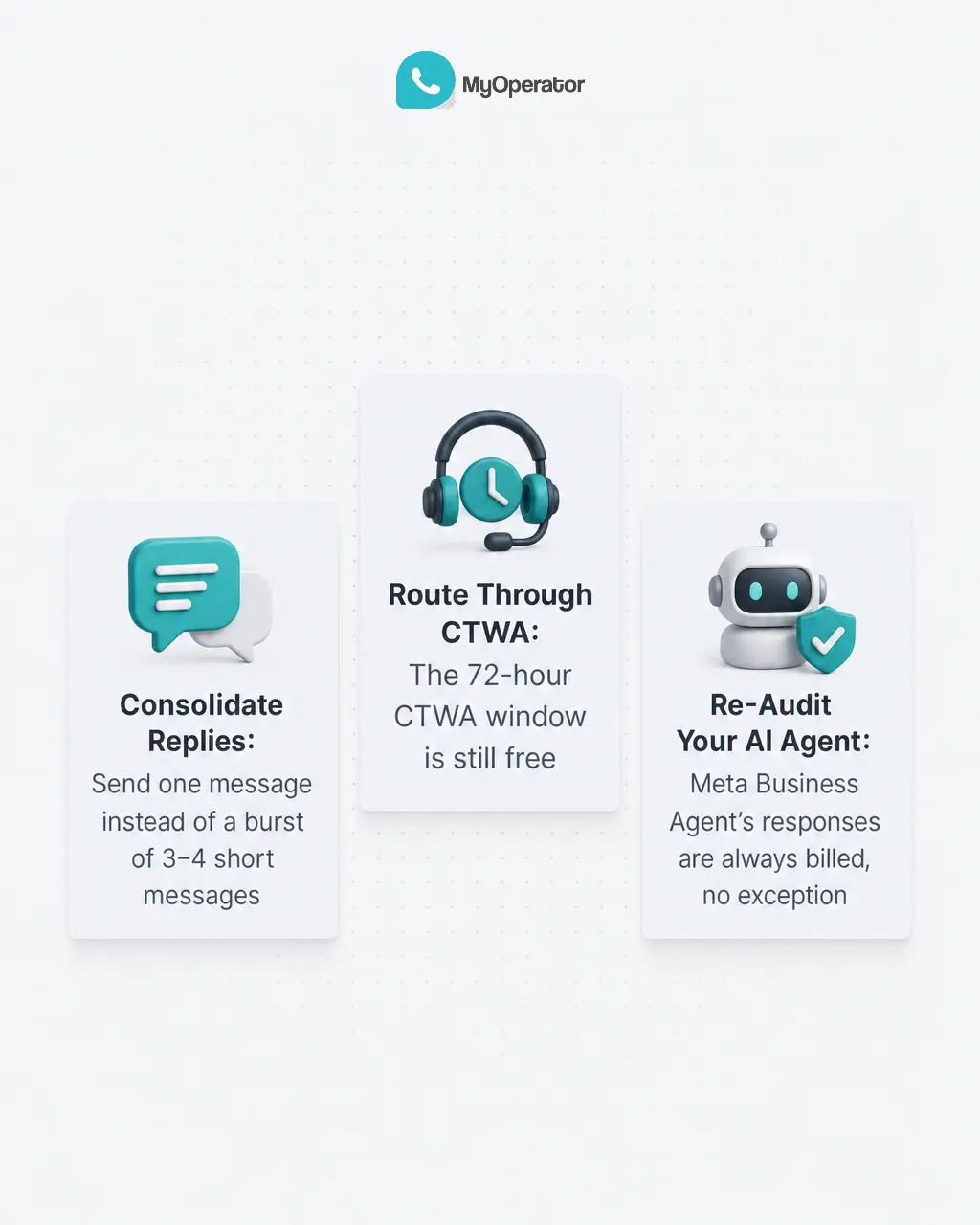
Meta sets the rate, but how much of it actually lands on your invoice comes down to habits you can change before October 1. Three adjustments make the biggest difference.
Consolidate WhatsApp replies
If your team or AI agent currently sends a burst of 3–4 short messages to answer one query, each one is now a separate ₹0.115 charge, excluding your BSP charges. Combining them into one complete reply cuts the per-conversation cost proportionally.
Route more volume through CTWA.
Since the 72-hour free window is unchanged, campaigns that bring customers in through Click-to-WhatsApp ads absorb more of the conversation at zero messaging cost. Customers who message you organically will still cost you to reply within the standard 24-hour window.
Know the Meta Business Agent exception.
The 72-hour Free Entry Point window waives message delivery fees for marketing, utility, authentication, and service messages when a chat starts from a Click-to-WhatsApp ad or Facebook CTA button. This doesn't cover Meta Business Agent’s responses which are billed separately on token consumption.
These moves aren't complicated, but they compound. Consolidate your replies and the message count drops. Route volume through the CTWA entry point and it drops again. Know whether your AI agent's responses qualify for the free window, and the cost drops a third time.
This piece has given you the exact messages that flip from free to charged and the moves that cut your bill before October 1. The one exception in the free window that most breakdowns miss entirely is the one worth remembering.
The businesses whose bills climb hardest are the ones treating this as a one-time fix. If you handle high support volume, have fragmented replies, and nobody to review your AI agent’s responses, MyOperator can help you.

.avif)



.webp)


